
Your data on MRCVSonline
The nature of the services provided by Vision Media means that we might obtain certain information about you.
Please read our Data Protection and Privacy Policy for details.

In addition, (with your consent) some parts of our website may store a 'cookie' in your browser for the purposes of
functionality or performance monitoring.
Click here to manage your settings.
If you would like to forward this story on to a friend, simply fill in the form below and click send.

Your friend's email:
Your email:
Your name:
 
 
Send Cancel

Blowfly risk should still be viewed as “high,” experts warn
“The strike risk should still be viewed as 'high' throughout most lowland areas of the UK."

A warm, wet autumn could lead to a significant rise in cases

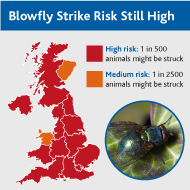
Blowfly strike risk remains “high” across much of the UK, according to the latest update from Elanco and the National Animal Disease Information Service.


The report shows that while a couple of areas have been downgraded to “Medium” (North Wales and East Scotland), the high blowfly population remains a threat. 


“This is probably the most difficult period to accurately forecast blowfly strike risk during the year because although fly populations remain high, egg-laying and maggot survival are highly dependent on the weather,” explained Richard Wall, professor of zoology and compiler of the Blowfly Risk Alerts.


“If it remains warm through September, risk will remain high, and because many of the treatments applied in early Summer are approaching the end of their period of residual protection, a warm wet autumn can lead to a big increase in strike cases.”

He continued: “The strike risk should still be viewed as 'high' throughout most lowland areas of the UK, but with appropriate note taken of the changing weather."

A study by Elanco and the National Farm Research Unit found that 99 per cent of farmers have suffered financial losses as a result of blowfly strike. A further 82 per cent agreed that the blowfly season is getting longer, with cases of strike being reported as early as February and as late as November.


The consequences of blowfly strike can be devastating, leading to welfare problems and production losses. Figures show it can cost up to £200 to breed a replacement ewe and as much as £80 loss per lamb per death.

Farmers and health professionals seeking to guard against blowfly this year can view real-time map reports at farmanimalhealth.co.uk.


 

Become a member or log in to add this story to your CPD history

Defra shares new Sanitary and Phytosanitary guidance

News Story 1
 Defra has published guidance for the vet sector ahead of a proposed UK-EU Sanitary and Phytosanitary agreement.


The agreement, which will change the movement and trade of animals and related products, could see reductions in checks, paperwork and certification. As well as describing regulatory developments, the advice highlights the importance of animal ID, registration and traceability in disease control and other compliance arrangements.

The guidance can be found here. More detail is expected as negotiations progress. 

Click here for more...
News Shorts
BSAVA publishes fifth Manual of Canine and Feline Neurology

The BSAVA has published the fifth edition of its BSAVA Manual of Canine and Feline Neurology.

The new edition has been reviewed and updated, including new developments in diagnostics, therapeutic approaches and clinical decision-making. It is structured to support clinicians through diagnosis, treatment and long-term management.

The guide features five new chapters covering acute myelopathies, chronic myelopathies, emergency protocols, neurotoxicology and neuro-oncology.

It also includes over 100 videos, including demonstrations of neurological examinations, clinical presentations and diagnostic procedures.

Nicola Lloyd, publishing manager, said: "Whether you're a general practitioner seeking practical guidance, or a specialist aiming to refine your expertise, this edition remains an indispensable reference for anyone involved in the care of neurologically compromised dogs and cats."