
Your data on MRCVSonline
The nature of the services provided by Vision Media means that we might obtain certain information about you.
Please read our Data Protection and Privacy Policy for details.

In addition, (with your consent) some parts of our website may store a 'cookie' in your browser for the purposes of
functionality or performance monitoring.
Click here to manage your settings.
If you would like to forward this story on to a friend, simply fill in the form below and click send.

Your friend's email:
Your email:
Your name:
 
 
Send Cancel

Outlook for Great Barrier Reef rated ‘very poor’
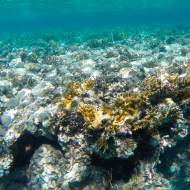
The most immediate threats are the gradual increase of sea temperature and extremes such as marine heat waves.
Report explores key threats to ecosystem

The long-term outlook for the Great Barrier Reef ecosystem has been officially downgraded, from ‘poor’ to ‘very poor’, according to a new report.

Researchers from the Great Barrier Reef Marine Park Authority (GBRMPA) said this is a critical point in the reef’s history, and there is an urgent need for accelerated action to improve it.

Key report findings:
  • coral reefs have overall declined to a very poor condition, after extensive coral mortality due to back-to-back coral bleaching events, cyclones and an ongoing crown-of-thorns starfish outbreak
  • the risk of several threats has increased since 2014, including altered ocean currents, artificial light and grounding of small vessels
  • the overall condition of habitats is poor. There has been habitat loss, degradation and alteration in a number of areas, affecting populations of dependent species such as some reef fish, marine turtles and seabirds
  • factors that influence and interact with the reef are intensifying, and while some can be managed or controlled, others - such as climate change - require global efforts
  • inshore water quality is improving at a regional level but the change is too slow
  • given the size of the region, its health and condition is variable and many areas continue to support healthy corals and marine life. Some species are thought to be recovering - humpback whale populations are healthy and southern green turtles are thought to be on the increase.

Chief scientist Dr David Wachenfeld said the most immediate threats are the gradual increase of sea temperature and extremes such as marine heat waves.

“Global action on climate change is critical,” he added. “Mitigating threats like climate change and poor water quality, coupled with resilience-based management, are essential to boosting Reef health so it can recover from major disturbances.”

Australian and Queensland Governments are investing over $2 billion in the next decade as part of a comprehensive plan to protect the reef.

Become a member or log in to add this story to your CPD history

Equine Disease Surveillance report released for Q4 2025

News Story 1
 The latest Equine Disease Surveillance report has been released, with details on equine disease from Q4 of 2025.

The report, produced by Equine Infectious Disease Surveillance, includes advice on rule changes for equine influenza vaccination.

Statistics and maps detail recent outbreaks of equine herpes virus, equine influenza, equine strangles and equine grass sickness. A series of laboratory reports provides data on virology, bacteriology, parasitology and toxicosis.

This issue also features a case study of orthoflavivus-associated neurological disease in a horse in the UK. 

Click here for more...
News Shorts
NSA webinar explores sheep tailing and castration

The National Sheep Association (NSA) is to host a free webinar on the castration and tail docking of lambs.

The webinar, 'Understanding the tailing and castration consultation: A guide for sheep farmers', will be hosted online on Monday, 2 March 2026 at 7.30pm.

It comes during a government consultation into the methods used for these procedures. Farmers are encouraged to engage before the consultation period closes on Monday, 9 March 2026.

The webinar offers clear and actionable guidance to support farmers to contribute meaningfully to the consultation and prepare for potential changes.

On the panel will be former SVS president Kate Hovers, farmer and vet Ann Van Eetvelt and SRUC professor in Animal Health and Veterinary Sciences Cathy Dwyer. Each panel member will utilise their own specialism and expertise to evaluate risks and outcomes to sheep farming.

Find out more about the webinar on the NSA website.

