Your data on MRCVSonline
The nature of the services provided by Vision Media means that we might obtain certain information about you.
Please read our Data Protection and Privacy Policy for details.

In addition, (with your consent) some parts of our website may store a 'cookie' in your browser for the purposes of
functionality or performance monitoring.
Click here to manage your settings.
If you would like to forward this story on to a friend, simply fill in the form below and click send.

Your friend's email:
Your email:
Your name:
 
 
Send Cancel

One in six farm vets suffer injuries - survey
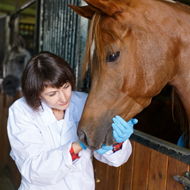
Eighty-one per cent of production animal vets who suffered injuries reported being kicked.
Robust health and safety procedures needed, BVA says 

Vets and farmers are being urged to develop robust health and safety procedures, after a survey revealed 61 per cent of vets working with production animals suffered injuries in a 12-month period.

Equine practice and mixed practice revealed similar results, with 65 per cent and 66 per cent injured by animals respectively.

One in five production animal vets responding to BVA’s Voice of the Veterinary Profession survey rated their injuries as either very or quite severe.

The most common injury was bruising caused by kicks, with 81 per cent of production animal vets who suffered injuries reporting this. Other injuries included crush injuries, lacerations, scratches and bites. Nearly a fifth of vets (19 per cent) had to take time off work as a result of their most severe injury.

BVA president Simon Doherty described his own experience of having to cease working in large animal practice after rupturing a spinal ligament while calving a heifer with a uterine torsion. He has also been stood on, kicked and suffered a broken arm whilst working with cattle, as well as experiencing back problems due to the physical aspects of repeated lambing and calvings.

“These figures show the serious risk of injury that production animal vets run in the course of their work, even when handling facilities are relatively good,” he said. “Animals on a farm can be large, heavy and unpredictable, and farmers and vets up and down the country have seen colleagues injured on farms and frequently unable to work as a result.”

Vets, farmers and veterinary employers are advised to reduce injuries and save lives by using health and safety assessments to minimise avoidable risks. This includes making sure facilities and restraining equipment, such as cattle crushes, pens, gates and escape routes, are safe and well-maintained.

The Health and Safety Executive (HSE), offers a guide, Farmwise, to give farmers practical advice on creating a safe environment for all workers. The British Equine Veterinary Association (BEVA) also offers guidance on workplace safety for those working with equines. 

Become a member or log in to add this story to your CPD history

Equine Disease Surveillance report released for Q4 2025

News Story 1
 The latest Equine Disease Surveillance report has been released, with details on equine disease from Q4 of 2025.

The report, produced by Equine Infectious Disease Surveillance, includes advice on rule changes for equine influenza vaccination.

Statistics and maps detail recent outbreaks of equine herpes virus, equine influenza, equine strangles and equine grass sickness. A series of laboratory reports provides data on virology, bacteriology, parasitology and toxicosis.

This issue also features a case study of orthoflavivus-associated neurological disease in a horse in the UK. 

Click here for more...
News Shorts
NSA webinar explores sheep tailing and castration

The National Sheep Association (NSA) is to host a free webinar on the castration and tail docking of lambs.

The webinar, 'Understanding the tailing and castration consultation: A guide for sheep farmers', will be hosted online on Monday, 2 March 2026 at 7.30pm.

It comes during a government consultation into the methods used for these procedures. Farmers are encouraged to engage before the consultation period closes on Monday, 9 March 2026.

The webinar offers clear and actionable guidance to support farmers to contribute meaningfully to the consultation and prepare for potential changes.

On the panel will be former SVS president Kate Hovers, farmer and vet Ann Van Eetvelt and SRUC professor in Animal Health and Veterinary Sciences Cathy Dwyer. Each panel member will utilise their own specialism and expertise to evaluate risks and outcomes to sheep farming.

Find out more about the webinar on the NSA website.