
Your data on MRCVSonline
The nature of the services provided by Vision Media means that we might obtain certain information about you.
Please read our Data Protection and Privacy Policy for details.

In addition, (with your consent) some parts of our website may store a 'cookie' in your browser for the purposes of
functionality or performance monitoring.
Click here to manage your settings.
If you would like to forward this story on to a friend, simply fill in the form below and click send.

Your friend's email:
Your email:
Your name:
 
 
Send Cancel

Parrot performs 16 dance moves, scientists say
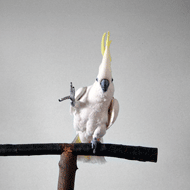
The recent study suggests there are five distinct capacities that form key evolutionary prerequisites for dancing to music. (Stock photo)
Snowball appears to have invented some of his own moves 

A parrot in the US can perform 16 distinct dance moves, some of which he appears to have invented himself, according to a new study.

The research, published in Current Biology, suggests that, like humans, parrots can respond to music using a wide variety of movements and body parts.

Over 10 years ago, researchers at Tufts University studied Snowball, a sulphur-crested cockatoo, bobbing his head to the beat of a Backstreet Boys song. This suggested that parrots, unlike most species, have the cognitive ability to anticipate a beat and move to it.

In the latest study, researchers found that Snowball can perform 16 different dance moves, none of which he has been trained to do. His dancing developed through social interaction with people and he appears to have made up some of the moves, as his owner Irene Schulz, a co-author on the study, does not make these moves when she dances with him.

Tufts researchers say that dancing to music is not just an arbitrary product of human culture.

Psychology professor Aniruddh Patel said: “It’s a response to music that arises when certain cognitive and neural capacities come together in animal brains.”

The recent study suggests there are five distinct capacities that form key evolutionary prerequisites for dancing to music.

“We think this helps explain why so few species - and no other primates - share our impulse to move to music in spontaneous and diverse ways,” he added.

Now the team hope to find out whether parrots - like humans - prefer to dance with another of their kind rather than alone.


Video by Bird Lovers Only Rescue Service

Image (c) Irena Schulz

Become a member or log in to add this story to your CPD history

FIVP publishes CMA Compliance Checklist

News Story 1
 FIVP has published a CMA Compliance Checklist to support independent practices with the Market Investigation Order.

The document includes deadlines for small and large businesses, with tick boxes for each of the tasks. The organisation also invites practices to contact them for support with requirements.

Rita Dingwall, FIVP chair, said: FIVP appreciates that navigating the new CMA requirements can feel daunting. We hope this checklist will make things a little easier, helping independent practices work through what is required with confidence. 

Click here for more...
News Shorts
APHA launches free virtual work experience programme

The Animal and Plant Health Agency (APHA), in collaboration with Springpod, has launched a free virtual work experience programme, giving young people across the UK the chance to explore careers dedicated to protecting animal and plant health.

The on-demand programme offers a unique insight into career opportunities within APHA, showcasing how students can contribute to tackling some of the UK's most critical biosecurity and environmental challenges.

Designed for students aged 13 and over, the course includes more than 10 hours of engaging content featuring real-life industry insights, scenario-based challenges, and practical guidance on applying for jobs. To register for the course, visit the APHA website.

