
Your data on MRCVSonline
The nature of the services provided by Vision Media means that we might obtain certain information about you.
Please read our Data Protection and Privacy Policy for details.

In addition, (with your consent) some parts of our website may store a 'cookie' in your browser for the purposes of
functionality or performance monitoring.
Click here to manage your settings.
If you would like to forward this story on to a friend, simply fill in the form below and click send.

Your friend's email:
Your email:
Your name:
 
 
Send Cancel

World-first brain surgery performed on kākāpō parrot
The young chick is said to have made a ‘remarkable recovery’ from the surgery.

Endangered chick has made a ‘remarkable recovery’, vets say 

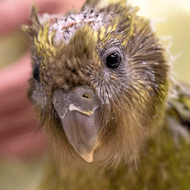
Vets in New Zealand have performed world-first brain surgery on an endangered kākāpō parrot, adapting techniques from human medicine.

The wild-hatched chick, now 60 days old, was born with a developmental problem of the skull.

Rangers from the department of conservation’s Kākāpō Recovery Team noticed an unusual lump on the bird’s skull just after hatching. A CT scan at the Dunedin Wildlife Hospital revealed the plates of the skull had not completely fused.

Professor Brett Gartrell, director of Massey University’s Wildbase Hospital, said: “The chick was hatched with a hole in its skull that allowed part of the brain and dura (the tough barrier around the brain) to herniate out.”

Led by Prof Gartrell, a team of veterinary surgeons and technicians made an elliptical incision around the area and reflected a flap of skin, allowing them to dissect out the herniated dura.

They were unable to reduce the herniated tissue back into the skull so a small piece of brain and dura were clamped and a small square of synthetic mesh was sutured over the open fontanelle. The mesh graft was then infused with bone marrow.

The chick is said to have made a ‘remarkable recovery’ and has been paired up with another chick at the Dunedin Wildlife Hospital, to reduce the risk of it imprinting on humans.

Image © Massey University

Become a member or log in to add this story to your CPD history

Animal Medicines Amnesty returns this November

News Story 1
 Veterinary practices are being urged to help owners safely dispose of any unused and expired pet medicines - not just antibiotics - during November's Animal Medicines Amnesty.

Organised by the Responsible Use of Medicines Alliance Companion Animal and Equine (RUMA CA&E), the initative is supported by a range of cross-sector organisations.

Practices are encouraged to use the campaign to engage the whole practice team and raise awareness of the safe disposal of medicines with clients. Learn how your practice can get involved at rumacae.org.uk 

Click here for more...
News Shorts
Bluetongue RZ extended across Scotland

The Scottish Government has announced an extension to a Bluetongue Restricted Zone that is in place in south-west Scotland.

From 3 October, the Restricted Zone will be extended to cover the whole of Scotland. The Animal, Plant and Health Agency (APHA) says this is in response to further disease spread, as well as simplify trading conditions ahead of the autumn.

Since the whole country will share a disease status, it will no longer be necessary to have a movement license to move susceptible livestock around the country. Restrictions on germinal products remain.

As of 1 October 2026, there were 1,979 cases of BTV-3 in England, 389 cases in Wales and 40 cases in Scotland.

