


Calls to better protect donkey welfare
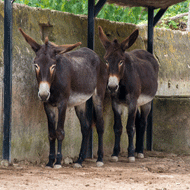
OIE says the global donkey population is now at risk, especially in Africa where they are a key target of the skin trade.
Legal and illegal trade in donkey skins is growing - OIE
The World Organisation for Animal Health (OIE) is calling for better implementation of its standards to protect donkey welfare, amid the growing trade in donkey skins.
Demand for diverse products of donkey origin, particularly skins, has risen rapidly, according to OIE. As a result, the legal and illegal trade has recently increased, with major implications for donkey health and welfare. Donkey skins are boiled to produce a gelatine called Ejiao, which is increasingly popular in Chinese medicine.
OIE says the global donkey population is now at risk, especially in Africa where they are a key target of the skin trade.
Major impacts of the trade include:
- welfare conditions during transport and slaughter are often reported as very poor, in both the legal and illegal trade
- animal diseases can spread to new areas when the global trade does not follow internationally agreed standards
- in the illegal trade, the slaughter of donkeys does not meet welfare standards and can become a source of contamination as carcasses are left to decompose in the open, impacting public health and the environment
- communities who rely on donkeys for their livelihoods may lose their animals, either by theft or choosing to sell them on for slaughter.
OIE sets international standards to improve animal health and welfare worldwide. In a statement it said: ‘Considering the impact and consequences of the increased global demand and trade of donkeys and their products, the OIE encourages its members to implement international standards, not only to protect donkey health and welfare, but also to safeguard the livelihoods that depend on them.’
The International Coalition for Working Equids (ICWE) welcomed the statement. Comprised of the Donkey Sanctuary, Brooke, SPANA and World Horse Welfare, the coalition has been working alongside OIE to implement welfare standards in African communities where disease has caused thousands of donkey fatalities in the past three months. The deaths have further depleted populations that have already been decimated by indiscriminate slaughter for skins.
Roly Owners, chair of ICWE, said: “We do not yet know the full extent of the impact of the donkey hide trade in Africa and of the loss of so many animals from disease, but ICWE members are ready to support communities and governments with technical advice to help implement the OIE standards.
“We echo the OIE’s concern about reports of illegal transport and slaughter of these donkeys for a trade which needs to be more humane and sustainable.”

 The latest



