


Calls to improve welfare of fish used in research
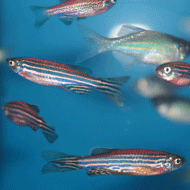
Zebrafish are now the second most commonly used lab animal in the country.
The RSPCA is calling for greater action to reduce the use and suffering of fish in scientific research, as recent figures suggest over half a million fish were used in experiments in 2017.
While rats, mice, dogs and monkeys are thought of as more common research animals, the charity is raising awareness of the rising number of fish being used for testing and research.
In the UK, fish were used in 16 per cent of experimental procedures in 2017, including as models for disease, to study how embryos develop, or to produce genetically altered animals. Zebrafish are now the second most commonly used lab animal in the country.
Dr Penny Hawkins, head of the RSPCA’s research animals department said: “Fish use in research and testing is becoming ever more commonplace, but sadly they are years behind mammals when it comes to being provided with an interesting environment, adequate pain relief and effective welfare assessment.”
This is despite evidence to suggest that fish have advanced cognitive abilities, including logical reasoning, counting and the ability to recognise individual human faces. One species, the cleaner wrasse, has even been found to outperform chimpanzees in a learning task, and also passed the ‘mirror test’, which suggests self awareness.
However, Dr Hawkins said fish are still sometimes seen as presenting less of an ethical and animal welfare issue than other animals in research.
“Unbelievably, fishes are sometimes described as ‘replacement alternatives’,” she added.
The charity is calling for greater consideration for lab fish when it comes to reducing suffering, animal welfare and replacing with humane alternatives.
Dr Hawkins said: “As fish use has risen, people within the scientific community are increasingly challenging assumptions about fishes being ‘lower’ animals, and pointing out that the ethical and animal welfare issues are not somehow solved by using fish instead of mammals.
“The RSPCA completely agrees, and wants to see vastly increased efforts being made to reduce the use and suffering of all animals in research, regardless of whether they have fur, feathers or fins.”


 Veterinary practices are being urged to help owners safely dispose of any unused and expired pet medicines - not just antibiotics - during November's Animal Medicines Amnesty.



