
Your data on MRCVSonline
The nature of the services provided by Vision Media means that we might obtain certain information about you.
Please read our Data Protection and Privacy Policy for details.

In addition, (with your consent) some parts of our website may store a 'cookie' in your browser for the purposes of
functionality or performance monitoring.
Click here to manage your settings.
If you would like to forward this story on to a friend, simply fill in the form below and click send.

Your friend's email:
Your email:
Your name:
 
 
Send Cancel

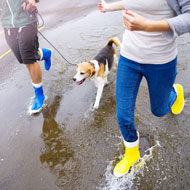
Dog owners ‘more likely to meet exercise guidelines’
Sixty four per cent of dog owners said they walk with their dogs for at least 150 minutes per week.

Health benefits should be recognised and facilitated, researchers say

Dog owners are four times more likely to complete the recommended level of physical activity per week than non dog owners, new research has confirmed.

It is recommended that adults do at least 150 minutes of moderate-to-vigorous exercise per week, but this is only achieved by 66 per cent of men and 58 per cent of women in England.

Whilst it is expected than dog ownership encourages physical activity, it has previously been unclear whether dog walking results in more physical activity, or simply replaces other forms of exercise.

According to a study by the University of Liverpool, published in Scientific Reports, 64 per cent of dog owners walk with their dogs for at least 150 minutes per week. Dog owners were found to walk more frequently and for longer periods than non dog owners. And this activity was carried out in addition to, not instead of other forms of physical activity.

Researchers studied the self-reported activity of 385 households in West Cheshire, comprising 191 dog owning adults, 455 non dog owning adults and 46 children.

Dr Carri Westgarth commented: “Our findings provide support for the role of pet dogs in promoting and maintaining positive health behaviours such as walking. Without dogs, it is likely that population physical activity levels would be much lower.

“The health benefits of dog ownership should be recognised and facilitated through the provision of dog-supportive walking environments and pet-friendly housing; failure of planning and policy makers to provide these may significantly damage population levels of physical activity.”


Become a member or log in to add this story to your CPD history

Defra shares new Sanitary and Phytosanitary guidance

News Story 1
 Defra has published guidance for the vet sector ahead of a proposed UK-EU Sanitary and Phytosanitary agreement.


The agreement, which will change the movement and trade of animals and related products, could see reductions in checks, paperwork and certification. As well as describing regulatory developments, the advice highlights the importance of animal ID, registration and traceability in disease control and other compliance arrangements.

The guidance can be found here. More detail is expected as negotiations progress. 

Click here for more...
News Shorts
BSAVA publishes fifth Manual of Canine and Feline Neurology

The BSAVA has published the fifth edition of its BSAVA Manual of Canine and Feline Neurology.

The new edition has been reviewed and updated, including new developments in diagnostics, therapeutic approaches and clinical decision-making. It is structured to support clinicians through diagnosis, treatment and long-term management.

The guide features five new chapters covering acute myelopathies, chronic myelopathies, emergency protocols, neurotoxicology and neuro-oncology.

It also includes over 100 videos, including demonstrations of neurological examinations, clinical presentations and diagnostic procedures.

Nicola Lloyd, publishing manager, said: "Whether you're a general practitioner seeking practical guidance, or a specialist aiming to refine your expertise, this edition remains an indispensable reference for anyone involved in the care of neurologically compromised dogs and cats."