
Your data on MRCVSonline
The nature of the services provided by Vision Media means that we might obtain certain information about you.
Please read our Data Protection and Privacy Policy for details.

In addition, (with your consent) some parts of our website may store a 'cookie' in your browser for the purposes of
functionality or performance monitoring.
Click here to manage your settings.
If you would like to forward this story on to a friend, simply fill in the form below and click send.

Your friend's email:
Your email:
Your name:
 
 
Send Cancel

New insights into link between high insulin levels and laminitis
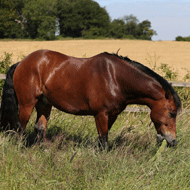
Acute endocrine laminitis is seen when ponies and some horses graze lush pasture or consume a diet that is rich in sugar or starch.

Antibody could aid development of new preventative drugs 

Scientists say they have shed new light on the link between high levels of insulin and equine laminitis.

It has been known for some time that high insulin levels can cause acute endocrine laminitis - the most common form of the condition - which is seen when ponies and some horses graze lush pasture or consume a diet that is rich in sugar or starch.

However, the mechanism by which insulin can produce effects in the foot leading to laminitis has been the subject of much debate in recent years. Scientists have previously been confused by the fact that insulin must interact with a specific receptor on the surface of cells to product an effect, but there do not appear to be any insulin receptors on hoof lamellar cells.

Researchers from the University of Melbourne and WALTHAM Equine Studies Group looked at the effect of insulin on equine hoof lamellar cells in the laboratory, exploring the similarities between insulin and a growth factor hormone called insulin-like growth factor -1 (IGF-1).

There are receptors for IGF-1 on the lamellar cells and the research team found high levels of insulin stimulated the cells to proliferate. In addition, this effect could be prevented with an antibody that specifically blocks just the IGF-1 receptor.

Changes within the cells were mainly linked to very high concentrations of insulin. Such concentrations are not commonly seen in normal horses considered to be at lower risk of laminitis, but can be seen in those with insulin dysregulation linked to equine metabolic syndrome.

Future research will look at how these cellular changes might cause laminitis, but researchers said it appears that targeting IGF-1 receptors may help with the development of new drugs to prevent laminitis.

Image © Spillers

 

Become a member or log in to add this story to your CPD history

New RCVS Academy courses to remove barriers in vet care

News Story 1
 The RCVS Academy has launched two courses to its new client support series, as it seeks to improve accessibility in veterinary settings.

The courses will help professionals to support assistance dog partnerships and clients with hearing loss.

The Hearing loss and Assistance dogs courses saw RCVS project lead Catherine Hemingway collaborate with the British Deaf Association and Assistance Dogs UK. Vets will gain practical guidance on supporting clients with additional needs.

Each course takes an hour to complete, and can be accessed by RCVS registrants for free. 

Click here for more...
News Shorts
APHA launches free virtual work experience programme

The Animal and Plant Health Agency (APHA), in collaboration with Springpod, has launched a free virtual work experience programme, giving young people across the UK the chance to explore careers dedicated to protecting animal and plant health.

The on-demand programme offers a unique insight into career opportunities within APHA, showcasing how students can contribute to tackling some of the UK's most critical biosecurity and environmental challenges.

Designed for students aged 13 and over, the course includes more than 10 hours of engaging content featuring real-life industry insights, scenario-based challenges, and practical guidance on applying for jobs. To register for the course, visit the APHA website.

