


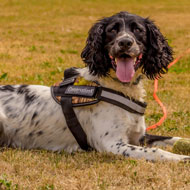
Springer spaniel Henry sniffs-out hedgehogs at risk of land development
A conservation detection dog is undergoing training to sniff-out nesting hedgehogs before their habitat is cleared for development.
Springer spaniel Henry is one of a group of conservation dogs from Conservation K9 Consultancy. Working with his trainers, Henry is learning to find hedgehogs in a range of different habitats and conditions, so they can be moved to safety.
The project is being led by Lucy Bearman-Brown, a senior lecturer in animal science at Hartpury University, in collaboration with the People’s Trust for Endangered Species and the British Hedgehog Preservation Society.
Together with Henry’s trainer Louise Wilson, Lucy finds hedgehogs the traditional way with spotlights and marks them with a small radio tracking device. Henry then scours the area so that Lucy can monitor how effective he is at locating the hedgehogs.
Next, to see if modern technology can help with detection rates, Lucy searches the area herself using thermal imaging cameras. Both methods are being tested in the winter, when hedgehogs are hibernating, and the summer, when they are active, to show just how much of a 'super-dog' Henry is.
“As we suspected, Henry’s already been finding hedgehogs that I couldn’t locate using traditional methods – he is incredible!” she said. “He is particularly good at finding hedgehogs hiding in thick undergrowth, much to the bemusement of Louise as she follows behind on the end of Henry’s lead.”
When Henry finds a hedgehog, he lets Louise know by sitting quietly nearby and looking at her. He then receives his reward, a game of fetch, away from the hedgehog.
“These early findings suggest we may soon have a new method that is more effective for finding hedgehogs at risk from land development, so we can move them out of harm’s way," Lucy continued. “The plan is that once this concept is proven, more dogs can be trained to help find hidden hedgehogs.
Image (C) Hartpury University.


 The BSAVA has opened submissions for the BSAVA Clinical Research Abstracts 2026.



