


Charities and organisations unite to tackle disease in Sub-Saharan Africa
The University of Liverpool, Brooke, SPANA (the Society for the Protection of Animals Abroad) and the Gambia Horse and Donkey Trust have teamed up to start a new five-year project to research the effects of epizootic lymphangitis (EZL) on equines and owners in Sub-Saharan Africa.
While EZL has not been present in the UK since 1906, the disease is still prevalent in the Sub-Saharan African area.
Horses, donkeys and mules are still relied upon in this region for farming and transport, and EZL can have a devastating effect on a herd as well as the owner’s family income.
The aim of the project is to gain more understanding of the disease and to develop effective action plans to prevent and treat. Not only will this improve the welfare for equines but it will also hold far reaching benefit over local communities.
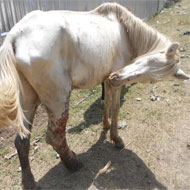
EZL is a fungal infection that is highly contagious and can result in pus-contained skin nodules and abscesses along the neck and limbs as well as swelling and lameness. The eyes and respiratory system may also be affected.
Brooke, a UK-based equine charity, has been present in Sub-Saharan Africa since 2001 and its funding programmes have helped an estimated 13 million equines across the region.
SPANA operates across developing countries and administers free veterinary treatment to working animals.
The Gambia Horse and Donkey Trust provides mobile veterinary clinics and also offers training in equine welfare to Gambians.
Donations to the Gambia Horse and Donkey Trust can be made here.
Donations to SPANA can be made here.
Donations to Brooke can be made here.
Image (c) Brooke


 Companies marketing medicines for small pets exempt from authorisation must submit their annual return to the Veterinary Medicines Directorate (VMD) by 30 November 2026.



