
Your data on MRCVSonline
The nature of the services provided by Vision Media means that we might obtain certain information about you.
Please read our Data Protection and Privacy Policy for details.

In addition, (with your consent) some parts of our website may store a 'cookie' in your browser for the purposes of
functionality or performance monitoring.
Click here to manage your settings.
If you would like to forward this story on to a friend, simply fill in the form below and click send.

Your friend's email:
Your email:
Your name:
 
 
Send Cancel

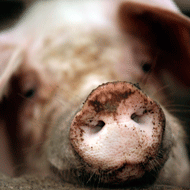
Pigs ‘could be a better model for human influenza’
The results suggest that targeting the lower respiratory tract with aerosol vaccination could be more effective in preventing severe disease.

’Striking difference’ to the same vaccine in pigs and ferrets 

A new study has raised questions about whether ferrets are a good model for studying human influenza.

Ferrets are considered to be a gold standard animal model for influenza research, but scientists now say that S-FLU - a universal flu vaccine candidate - evokes different immune responses in pigs and ferrets.

Findings published in the Journal of Immunology suggest that pigs may offer a more faithful representation of influenza disease in humans.

S-FLU is a weakened strain of flu virus, designed to trigger a response from T cells that are able to react to multiple strains of flu.

Researchers found a ‘striking difference’ in the way that pigs and ferrets responded to the same vaccine. When administered to pigs, the vaccine activated a newly-identified type of T cell, against a flu virus of a different strain. Disease severity was reduced, but the amount of virus stayed the same.

When it was administered to ferrets, however, the viral replication was reduced, as was the amount of virus transmitted to other animals. Scientists said pigs provide a model that is closer in size and has a very similar respiratory system to humans. Pigs are also naturally infected with influenza viruses.

The team’s discovery of a new type of T cell - tissue-resident memory T-cells - also sheds light on how influenza is fought in the lung.

The results also suggest that targeting the lower respiratory tract with aerosol vaccination could be more effective in preventing severe disease in pigs. This finding offers promising evidence that the same could be true in humans.


Become a member or log in to add this story to your CPD history

Submissions open for BSAVA Clinical Research Abstracts 2026

News Story 1
 The BSAVA has opened submissions for the BSAVA Clinical Research Abstracts 2026.

It is an opportunity for applicants to present new research on any veterinary subject, such as the preliminary results of a study, discussion of a new technique or a description of an interesting case.

They must be based on high-quality clinical research conducted in industry, practice or academia, and summarised in 250 words.

Applications are welcome from vets, vet nurses, practice managers, and students.

Submissions are open until 6 March 2026. 

Click here for more...
News Shorts
Survey seeks ruminant sector views on antimicrobial stewardship

A new survey is seeking views of people working in the UK ruminant sector on how to tackle the challenge of demonstrating responsible antibiotic stewardship.

Forming part of a wider, collaborative initiative, the results will help identify the types of data available so that challenges with data collection can be better understood and addressed.

Anyone working in the UK farming sector, including vets and farmers,is encouraged to complete the survey, which is available at app.onlinesurveys.jisc.ac.uk
