


BVA president praises Scotland on animal welfare policies
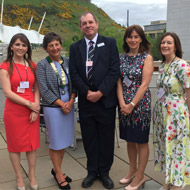
BVA president John Fishwick with Scottish Branch members at the organisation's annual Scottish dinner.
BVA president John Fishwick has praised the Scottish government for ‘leading the pack’ on animal welfare.
Speaking at the BVA’s annual Scottish dinner on Tuesday (15 May), Mr Fishwick said: “Scotland has really led the way on developing policies that keep animal health and welfare front and centre over the past year, and it’s been especially heartening when this has also prompted movement and debate on crucial pieces of legislation across the rest of the UK.”
More than 100 people attended the BVA's annual Scottish dinner, which was held in the Scottish Parliament. Guests included environment secretary Roseanna Cunningham, parliamentarians, key representatives from animal health and welfare organisations, and colleagues from across the veterinary profession.
Mr Fishwick underscored several policies that prioritise keeping animals happy and healthy, including the vote to ban the use of wild animals in circuses and a commitment from the Scottish Government to take steps towards banning the use of electric shock collars.
He also touched on the work of various projects that address recruitment and retention challenges in the workforce or provide mental health support to vets. Commenting on the work of the National Rural Mental Health Forum and the ‘Developing the Veterinary Landscape in Scotland’ project, he said:
“The projects have much to do, but it is incumbent on the veterinary profession to tackle issues together and ensure that the workforce is resilient and well-supported now and going into the future.”
Mr Fishwick also spoke about the challenges and opportunities posed by Brexit and urged the guests to support BVA’s call for the Home Office to place vets on the shortage occupation list. Research conducted by the RCVS suggests that one in five vets is now actively looking for work outside the UK, with 44 per cent saying they are ‘fearful’ about what the future might hold.
“There are over 2,200 vets working in Scotland, and of these 14 per cent are non-UK EU graduates,” Mr Fishwick said. “Many of these are playing a crucial role in supporting Scotland’s agricultural industry as a cornerstone of the economy.
“The impact of the loss of even a small percentage of the veterinary workforce could have serious repercussions, especially in slaughterhouses, where it’s estimated that 95 per cent of vets delivering vital public health roles are from overseas, mostly the EU.”


 Companies marketing medicines for small pets exempt from authorisation must submit their annual return to the Veterinary Medicines Directorate (VMD) by 30 November 2026.



