


Honey bee colonies shed light on human brain
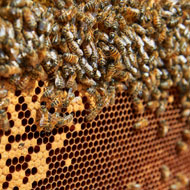
"...parallels between bees in a colony and neurons in a brain can be traced."
Honey bee colonies adhere to the same laws as the human brain when making collective decisions, a new study has found.
Scientists say the findings could help us to understand the basic mechanisms of human behaviour, and the psychophysical laws governing the brains of humans and other animals.
A team from the University of Sheffield studied a theoretical model of how honey bees decide where to build their nests, viewing the bee colony as a single superorganism - similar to the human brain - which displays a co-ordinated response to external stimuli.
Findings published in Nature: Scientific Reports show that the way in which bees ‘talk’ to each other and make decisions is similar to the way individual neurons in the brain interact with one another.
Previous research has shown that the brain of humans and other animals follow certain rules, known as psychophysical laws. Single brain neurons do not obey these rules, but the brain as a whole does. Similarly, this study found that while single bees may not obey these laws, the colony will, which suggests that the mechanisms generating these psychophysical laws are not only happening in brains as previously thought.
The study also found that the colony is quicker to choose between two high-quality nest sites, compared to two low-quality sites; and slower to make choices when the number of nest sites increased. In humans, these phenomena are known as Pieron’s Laws and Hick’s Law respectively.
In addition, bee colonies were found to follow Weber’s Law, which finds that the brain is able to select the best quality option when there is a minimum difference between the qualities of the options.
Dr Andreagiovanni Reina commented: “This study is exciting because it suggests that honeybee colonies adhere to the same laws as the brain when making collective decisions.
“The study also supports the view of bee colonies as being similar to complete organisms or better still, superorganisms, composed of a large number of fully developed and autonomous individuals that interact with each other to bring forth a collective response.
“With this view in mind, parallels between bees in a colony and neurons in a brain can be traced, helping us to understand and identify the general mechanisms underlying psychophysics laws, which may ultimately lead to a better understanding of the human brain.
“Finding similarities between the behaviour of honeybee colonies and brain neurons is useful because the behaviour of bees selecting a nest is simpler than studying neurons in a brain that makes decisions.”


 Companies marketing medicines for small pets exempt from authorisation must submit their annual return to the Veterinary Medicines Directorate (VMD) by 30 November 2026.



