Your data on MRCVSonline
The nature of the services provided by Vision Media means that we might obtain certain information about you.
Please read our Data Protection and Privacy Policy for details.

In addition, (with your consent) some parts of our website may store a 'cookie' in your browser for the purposes of
functionality or performance monitoring.
Click here to manage your settings.
If you would like to forward this story on to a friend, simply fill in the form below and click send.

Your friend's email:
Your email:
Your name:
 
 
Send Cancel

Oxytocin key to human-canine interaction, study suggests
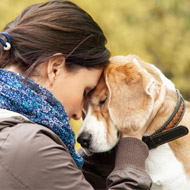
Oxytocin appears to help dogs form a strong bond with their owners.
Hormone appears to enhance dogs’ emotional recognition

Scientists have found that oxytocin makes dogs interested in smiling human faces. The finding suggests that the hormone could play a key role in the interaction between dogs and humans.

“It seems that the hormone oxytocin influences what the dog sees and how it experiences the thing it sees,” said doctoral student Sanni Somppi from the University of Helsinki.

In the study, researchers showed 43 dogs images of smiling and angry faces on a computer screen.They tested each dog twice - once whilst the dog was under the influence of oxytocin and once whilst they were not.

Researchers used an eye-tracking device to measure the dogs’ gaze on the images and pupil size. Studies show that emotions and attentiveness guide the gaze and regulate pupil size, making eye tracking a window to the dogs’ minds.

Besides making the dogs more attracted the smiling faces, oxytocin also appeared to influence thier emotional states. This was evident by the size of their pupils.

Without oxytocin, the dogs’ pupils were biggest when they looked at pictures of angry faces. This indicated that the angry faces prompted the most powerful, emotional reaction in the dogs.

Under the influence of oxytocin, however, images of smiling faces enhanced the dogs' emotional states more than angry faces. This suggests that oxytocin probably made the angry faces appear less threatening and the smiling faces more appealing.

“Both effects promote dog-human communication and the development of affectionate relations,” says Professor Outi Vainio, who heads the University of Helsinki's Canine Mind Project.

The study, Nasal Oxytocin Treatment Biases Dogs’ Visual Attention and Emotional Response toward Positive Human Facial Expressions, is published in Frontiers in Psychology

Become a member or log in to add this story to your CPD history

Equine Disease Surveillance report released for Q4 2025

News Story 1
 The latest Equine Disease Surveillance report has been released, with details on equine disease from Q4 of 2025.

The report, produced by Equine Infectious Disease Surveillance, includes advice on rule changes for equine influenza vaccination.

Statistics and maps detail recent outbreaks of equine herpes virus, equine influenza, equine strangles and equine grass sickness. A series of laboratory reports provides data on virology, bacteriology, parasitology and toxicosis.

This issue also features a case study of orthoflavivus-associated neurological disease in a horse in the UK. 

Click here for more...
News Shorts
NSA webinar explores sheep tailing and castration

The National Sheep Association (NSA) is to host a free webinar on the castration and tail docking of lambs.

The webinar, 'Understanding the tailing and castration consultation: A guide for sheep farmers', will be hosted online on Monday, 2 March 2026 at 7.30pm.

It comes during a government consultation into the methods used for these procedures. Farmers are encouraged to engage before the consultation period closes on Monday, 9 March 2026.

The webinar offers clear and actionable guidance to support farmers to contribute meaningfully to the consultation and prepare for potential changes.

On the panel will be former SVS president Kate Hovers, farmer and vet Ann Van Eetvelt and SRUC professor in Animal Health and Veterinary Sciences Cathy Dwyer. Each panel member will utilise their own specialism and expertise to evaluate risks and outcomes to sheep farming.

Find out more about the webinar on the NSA website.