
Your data on MRCVSonline
The nature of the services provided by Vision Media means that we might obtain certain information about you.
Please read our Data Protection and Privacy Policy for details.

In addition, (with your consent) some parts of our website may store a 'cookie' in your browser for the purposes of
functionality or performance monitoring.
Click here to manage your settings.
If you would like to forward this story on to a friend, simply fill in the form below and click send.

Your friend's email:
Your email:
Your name:
 
 
Send Cancel

Horse study offers new insights on human disease

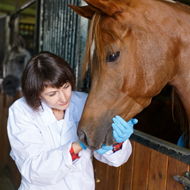
AHT scientists were working on Streptococcus equi, which causes strangles in horses.
Scientists ID genes linked with Streptococcus pyogenes

Research in horses has managed to identify new genes that are associated with Streptococcus pyogenes, an important cause of human disease.

Streptococcus pyogenes are responsible for 600 million cases of pharyngitis in humans every year, and infections caused by the bug have seen a dramatic rise around the world over the past 20 years.

The bacteria is also to blame for a further 100 million cases of invasive disease, such as scarlet fever, acute rheumatic fever and necrotising fasciitis.

Despite the cost to human health, the Animal Health Trust (AHT) said little is known about which of the 1,800 genes are required for it to infect people and persist in the throat.

AHT scientists were working on Streptococcus equi, which causes strangles in horses and is closely related to Streptococcus pyogenes. They developed a new technique that allows the importance of every gene in the bug to be tested at once, rather than one at a time.

The technique was transferred to the lab at Houston Methodist Research Institute, where it was also proved effective in the study of Streptococcus pyogenes. The team were able to identify 92 genes that were required for the bacteria to grow in human saliva.

Dr James Musser, a professor at the institute, said this has the potential to accelerate research into this important human pathogen.

In follow-on tests, the team were able to immediately confirm that six of these new genes did affect growth in human saliva, meaning there is potential for novel therapeutics and vaccines.

Dr Andrew Waller, head of bacteriology at AHT, added: “We are delighted that a technique developed at the AHT to learn more about Streptococcus equi and strangles in horses has provided new results that could benefit people too.

“We have learnt a huge amount about our bug through following the work being done on human diseases, and it is great to be able to give something back in return. This study highlights the similarities of animal and human pathogens.

“We hope that our technique will also prove useful for the study and prevention of other diseases, regardless of the animal they affect.”

Become a member or log in to add this story to your CPD history

Equine Disease Surveillance report released for Q4 2025

News Story 1
 The latest Equine Disease Surveillance report has been released, with details on equine disease from Q4 of 2025.

The report, produced by Equine Infectious Disease Surveillance, includes advice on rule changes for equine influenza vaccination.

Statistics and maps detail recent outbreaks of equine herpes virus, equine influenza, equine strangles and equine grass sickness. A series of laboratory reports provides data on virology, bacteriology, parasitology and toxicosis.

This issue also features a case study of orthoflavivus-associated neurological disease in a horse in the UK. 

Click here for more...
News Shorts
NSA webinar explores sheep tailing and castration

The National Sheep Association (NSA) is to host a free webinar on the castration and tail docking of lambs.

The webinar, 'Understanding the tailing and castration consultation: A guide for sheep farmers', will be hosted online on Monday, 2 March 2026 at 7.30pm.

It comes during a government consultation into the methods used for these procedures. Farmers are encouraged to engage before the consultation period closes on Monday, 9 March 2026.

The webinar offers clear and actionable guidance to support farmers to contribute meaningfully to the consultation and prepare for potential changes.

On the panel will be former SVS president Kate Hovers, farmer and vet Ann Van Eetvelt and SRUC professor in Animal Health and Veterinary Sciences Cathy Dwyer. Each panel member will utilise their own specialism and expertise to evaluate risks and outcomes to sheep farming.

Find out more about the webinar on the NSA website.

