Your data on MRCVSonline
The nature of the services provided by Vision Media means that we might obtain certain information about you.
Please read our Data Protection and Privacy Policy for details.

In addition, (with your consent) some parts of our website may store a 'cookie' in your browser for the purposes of
functionality or performance monitoring.
Click here to manage your settings.
If you would like to forward this story on to a friend, simply fill in the form below and click send.

Your friend's email:
Your email:
Your name:
 
 
Send Cancel

Housing zebrafish in groups reduces anxiety, study finds
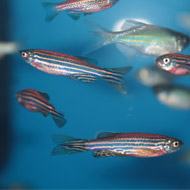
Zebrafish housed in groups returned to normal faster than individuals or pairs.
Researchers compare recovery from procedures like anaesthesia

Zebrafish housed in groups show lower levels of stress and anxiety when they undergo stressful procedures than those who are housed alone, new research has found.

Fish are increasingly being used in scientific research and there is growing evidence to show they experience stress and respond to pain in a similar way to mammals.

In the study, researchers compared recovery from procedures like anaesthesia and fin clipping in male zebrafish house individually, in pairs and in groups of six. The team analysed stress responses, such as time spent at the bottom of the tank, erratic movement and cortisol levels.

They found that anaesthesia alone and anaesthesia with fin clipping both had a significant impact on zebrafish housed alone. Both of these groups showed increased stress and behavioural alterations.

The team notes that responses of zebrafish housed in groups was less pronounced, with group-housed fish resuming normal behaviour faster than individuals or pairs. These fish also showed the lowest cortisol increase.

During the study, the researchers also confirmed that water-borne cortisol from tanks is an accurate measure of stress in zebrafish. This method avoids the need for terminal sampling, helping to reduce the number of fish required for studies on psychological stress, they add.

The research, published in the journal Animal Behaviour, was led by the University of Liverpool.

Become a member or log in to add this story to your CPD history

Submissions open for BSAVA Clinical Research Abstracts 2026

News Story 1
 The BSAVA has opened submissions for the BSAVA Clinical Research Abstracts 2026.

It is an opportunity for applicants to present new research on any veterinary subject, such as the preliminary results of a study, discussion of a new technique or a description of an interesting case.

They must be based on high-quality clinical research conducted in industry, practice or academia, and summarised in 250 words.

Applications are welcome from vets, vet nurses, practice managers, and students.

Submissions are open until 6 March 2026. 

Click here for more...
News Shorts
Survey seeks ruminant sector views on antimicrobial stewardship

A new survey is seeking views of people working in the UK ruminant sector on how to tackle the challenge of demonstrating responsible antibiotic stewardship.

Forming part of a wider, collaborative initiative, the results will help identify the types of data available so that challenges with data collection can be better understood and addressed.

Anyone working in the UK farming sector, including vets and farmers,is encouraged to complete the survey, which is available at app.onlinesurveys.jisc.ac.uk