


Equine expert calls for lameness redefinition
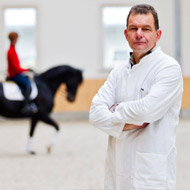
Professor René Van Weeren.
An equine expert has suggested that lameness needs to be redefined to reflect new digital assessment techniques.
In a paper published in the Equine Veterinary Journal, René Van Weeren - a professor of equine musculoskeletal biology at Utrecht University - points out that digital systems rely on preset parameters to decide about lameness and that this can present obstacles.
He writes that thresholds are based on a limited reference population, which doesn’t accurately reflect the millions of horses in the world. The individual environmental and mental conditions for each horse are not accounted for. As such, to use the term ‘lame’ because a horse demonstrated a subtle gait alteration could be inappropriate, particularly as it may not affect the horse’s welfare in any way.
Professor Van Weeren said: “Digital equine gait analysis is sure to become an indispensable additional tool for clinical decision-making. At this early stage, we must define the use of terminology in order to avoid confusion and to prevent the formation of wrong perceptions.
“Using the term “lame” for any horse falling beyond thresholds set for quantitative gait analysis or not showing the ideal motion pattern when assessed clinically is inadvisable. We should reserve the use of that term for horses deemed unfit to compete based on a comprehensive assessment of the animal that includes, but does not rely entirely on, the appreciation of the degree of gait asymmetry.”
The traditional method for detecting lameness is subjective, using expert visual evaluation of gait to identify the presence or absence and degree of asymmetries. Lame horses are described as having a disorder, defect or loss of function and this clinical diagnosis has associated welfare implications if the horse is still asked to perform.
But advanced digital technology is starting to change all this. Optic motion capture or the use of inertial measurement units is now allowing researchers to study and quantify the horse’s gait; objective assessment against preset thresholds.
Professor Celia Marr, editor of the Equine Veterinary Journal said: “An important first step is for researchers and clinicians to start to discriminate clearly between ‘asymmetry’ and ‘lameness’ and not to use these as interchangeable terms when interpreting gait analysis data. Asymmetry is often, but not always, a hallmark of lameness, but is not a clinical term, whereas lameness is.”
The paper, Do we have to redefine lameness in the era of quantitative gait analysis, is published in the Autumn issue of the Equine Veterinary Journal. The paper is available free online at http://onlinelibrary.wiley.com/doi/10.1111/evj.12715/full .


 Defra has published guidance for the vet sector ahead of a proposed UK-EU Sanitary and Phytosanitary agreement.



