
Your data on MRCVSonline
The nature of the services provided by Vision Media means that we might obtain certain information about you.
Please read our Data Protection and Privacy Policy for details.

In addition, (with your consent) some parts of our website may store a 'cookie' in your browser for the purposes of
functionality or performance monitoring.
Click here to manage your settings.
If you would like to forward this story on to a friend, simply fill in the form below and click send.

Your friend's email:
Your email:
Your name:
 
 
Send Cancel

Rabies vaccination programme gets underway in Kabul
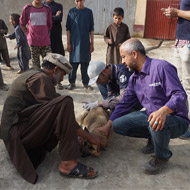
Dr Mohammadzai DVM (right) during the first day of the vaccination programme.

Local vets working to end the culling of free-roaming dogs

Animal welfare charity Mayhew International has begun its first ever mass rabies vaccination programme in Kabul, Afghanistan.

In January, Mayhew negotiated a landmark agreement with authorities to end the culling of free-roaming dogs in Kabul. Since then, Mayhew’s Afghanistan country director, Dr Abdul-Jalil Mohammadzai DVM, has been setting up the charity’s NGO facilities and working to implement a long-term and sustainable animal welfare strategy.

The mass rabies vaccination programme began on Sunday (6 August) and will cover the 16 main districts of Kabul. Local staff, including vets and other veterinary professionals, have been employed by the charity to help deliver the programme and will work as vaccinators, surveyors and data recorders.

Mayhew has decribed the programmes so far as a ‘huge success’, generating lots of interest from the locals and a ‘good start’ to their target of vaccinating up to 15,000 dogs.

“Our mass rabies vaccination programme is very much welcomed by the government and the people in Kabul. We presently have a team of 16 staff who are working on the field and for the initial days, a small team from Ranchi in India. Everybody is very supportive,” commented Dr Mohammadzai.

“We believe that educating communities is the key to spreading the word about rabies prevention, safe interaction with community dogs, compassion towards animals and the benefits of neutering.”

Mathew International provides international veterinary training and works overseas to find sustainable solutions to the free-roaming dog and cat populations in Afghanistan, Georgia, Russia and India.

The organisation states that it will continue working with authorities to reach their goal of creating a safer and more secure environment for both the people and animals of Kabul.

Image (C) Mayhew International

Become a member or log in to add this story to your CPD history

Defra shares new Sanitary and Phytosanitary guidance

News Story 1
 Defra has published guidance for the vet sector ahead of a proposed UK-EU Sanitary and Phytosanitary agreement.


The agreement, which will change the movement and trade of animals and related products, could see reductions in checks, paperwork and certification. As well as describing regulatory developments, the advice highlights the importance of animal ID, registration and traceability in disease control and other compliance arrangements.

The guidance can be found here. More detail is expected as negotiations progress. 

Click here for more...
News Shorts
BSAVA publishes fifth Manual of Canine and Feline Neurology

The BSAVA has published the fifth edition of its BSAVA Manual of Canine and Feline Neurology.

The new edition has been reviewed and updated, including new developments in diagnostics, therapeutic approaches and clinical decision-making. It is structured to support clinicians through diagnosis, treatment and long-term management.

The guide features five new chapters covering acute myelopathies, chronic myelopathies, emergency protocols, neurotoxicology and neuro-oncology.

It also includes over 100 videos, including demonstrations of neurological examinations, clinical presentations and diagnostic procedures.

Nicola Lloyd, publishing manager, said: "Whether you're a general practitioner seeking practical guidance, or a specialist aiming to refine your expertise, this edition remains an indispensable reference for anyone involved in the care of neurologically compromised dogs and cats."
