
Your data on MRCVSonline
The nature of the services provided by Vision Media means that we might obtain certain information about you.
Please read our Data Protection and Privacy Policy for details.

In addition, (with your consent) some parts of our website may store a 'cookie' in your browser for the purposes of
functionality or performance monitoring.
Click here to manage your settings.
If you would like to forward this story on to a friend, simply fill in the form below and click send.

Your friend's email:
Your email:
Your name:
 
 
Send Cancel

Trial shows promise for facial tumour cure
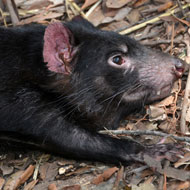
Lead author Dr Cesar Tovar said the findings confirm it is possible to trigger the devil’s immune system to recognise and destroy DFTD tumours.
Immunotherapy shrank tumours in Tasmanian devils

Scientists say they have had a ‘eureka’ moment in using immunotherapy to cure Tasmanian devils of the deadly devil facial tumour disease (DFTD).

Led by the University of Tasmania, an international research team used immunotherapy on devils with golf-ball-sized tumours and observed the tumours shrinking and disappearing over a period of three months.

“This is almost a eureka moment for us because it’s the first time we can say for sure that it was the immunotherapy that was making the tumour shrink,” said Professor Greg Woods, who led the team at the university’s Menzies Institute for Medical Research.

Lead author Dr Cesar Tovar added that the findings confirm it is possible to trigger the devil’s immune system to recognise and destroy DFTD tumours.

“Our research shows that a DFTD vaccine is feasible. We are focusing our efforts on developing strategies to improve the devils’ response to immunisation.”

The breakthrough is the next step on from research published in 2015, which revealed the devil’s immune system was capable of mounting an immune response to DFTD.

“This is an important step along the way to developing a vaccine to protect against DFTD and potentially to cure devils of established DFTD,” Prof Woods added.

Become a member or log in to add this story to your CPD history

Equine Disease Surveillance report released for Q4 2025

News Story 1
 The latest Equine Disease Surveillance report has been released, with details on equine disease from Q4 of 2025.

The report, produced by Equine Infectious Disease Surveillance, includes advice on rule changes for equine influenza vaccination.

Statistics and maps detail recent outbreaks of equine herpes virus, equine influenza, equine strangles and equine grass sickness. A series of laboratory reports provides data on virology, bacteriology, parasitology and toxicosis.

This issue also features a case study of orthoflavivus-associated neurological disease in a horse in the UK. 

Click here for more...
News Shorts
Applications open for BEVA Back in the Saddle

The British Equine Veterinary Association (BEVA) has opened applications for its 'Back in the Saddle' coaching programme.

The online scheme offers structured group coaching for members wanting to reflect on their career path and regain clarity. Members may be returning to work after leave, uncertain about next steps or reassessing direction.

Attendees will benefit from impartial guidance and practical tools to support their professional development. Members are encouraged to take a 'proactive, future-focused approach' to their careers.

The sessions, taking place on Wednesdays from 7.30pm-9pm, are open to BEVA members with more than five years' experience. The first session takes place on Wednesday, 3 June 2026.

Applications will close on Wednesday, 27 May 2026.

