
Your data on MRCVSonline
The nature of the services provided by Vision Media means that we might obtain certain information about you.
Please read our Data Protection and Privacy Policy for details.

In addition, (with your consent) some parts of our website may store a 'cookie' in your browser for the purposes of
functionality or performance monitoring.
Click here to manage your settings.
If you would like to forward this story on to a friend, simply fill in the form below and click send.

Your friend's email:
Your email:
Your name:
 
 
Send Cancel

Over four million pets unneutered, report says
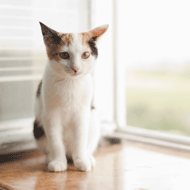
Myths and misconceptions may be partly to blame for the high proportion of unneutered pets, PDSA believes.
PDSA warning about life-threatening illnesses

New PDSA figures reveal 4.4 million pets are unneutered in the UK, leaving them at risk of dangerous conditions such as womb infections and cancers.

Nearly three million dogs, 770,000 cats and 720,000 rabbits are not neutered, estimates in the charity’s latest PAW report suggest.  To coincide with World Spay Day today (28 February), PDSA vets are urging owners to get their pets neutered.

The main reasons owners gave for not getting their pets neutered were: ‘Haven’t thought about it’ (22 per cent), ‘Don’t believe in it’ (16 per cent) and ‘Not got round to it’ (14 per cent).

Neutering levels vary across the UK, with the north east topping the list for unneutered pets at one in four (26 per cent), compared with 16 per cent of pets in the south east.

Myths and misconceptions may be partly to blame for the high proportion of unneutered pets, PDSA believes.

Charity vet Rebecca Ashman comments: “As a vet, I’ve heard many reasons why people are reluctant to have their pets neutered, ranging from worrying it will emasculate their pets, to concern about denying a pet’s parental rights. The reality is that animals don’t experience emotions in the same way we do. There’s no evidence to suggest there is an emotional cost to animals when they don’t have a litter. If owners have concerns about their pet having an anaesthetic and surgery, their vet or vet nurse will be able to put their minds at rest.

“There is also a fear that neutering will change your pet’s personality. Again, this a common misconception: neutering can reduce testosterone-fuelled behaviours – such as aggression – but this is not the same as changing their nature, which is shaped by genetics and life experiences. If owners have any questions, I’d always recommend they speak to their vet, who can give them specific advice for their pet and address any concerns.”

Unplanned pregnancies can be stressful and expensive, particularly if there are complications, PDSA says. It can also be difficult to find loving new homes for the offspring, with many pets ending up in rescue centres.

Become a member or log in to add this story to your CPD history

Equine Disease Surveillance report released for Q4 2025

News Story 1
 The latest Equine Disease Surveillance report has been released, with details on equine disease from Q4 of 2025.

The report, produced by Equine Infectious Disease Surveillance, includes advice on rule changes for equine influenza vaccination.

Statistics and maps detail recent outbreaks of equine herpes virus, equine influenza, equine strangles and equine grass sickness. A series of laboratory reports provides data on virology, bacteriology, parasitology and toxicosis.

This issue also features a case study of orthoflavivus-associated neurological disease in a horse in the UK. 

Click here for more...
News Shorts
NSA webinar explores sheep tailing and castration

The National Sheep Association (NSA) is to host a free webinar on the castration and tail docking of lambs.

The webinar, 'Understanding the tailing and castration consultation: A guide for sheep farmers', will be hosted online on Monday, 2 March 2026 at 7.30pm.

It comes during a government consultation into the methods used for these procedures. Farmers are encouraged to engage before the consultation period closes on Monday, 9 March 2026.

The webinar offers clear and actionable guidance to support farmers to contribute meaningfully to the consultation and prepare for potential changes.

On the panel will be former SVS president Kate Hovers, farmer and vet Ann Van Eetvelt and SRUC professor in Animal Health and Veterinary Sciences Cathy Dwyer. Each panel member will utilise their own specialism and expertise to evaluate risks and outcomes to sheep farming.

Find out more about the webinar on the NSA website.

