


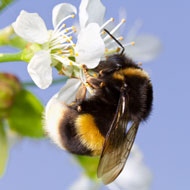
Study quells idea that bees have only simple learning abilities
Researchers have trained bumblebees to score goals using mini-balls, suggesting that they are more adept at learning than previously thought.
Previous studies have looked at how bees can solve cognitive tasks such as pulling strings to obtain food. However, this new study analysed tasks that are not naturally encountered by the insects.
“Our study puts the final nail in the coffin of the idea that small brains constrain insects to have limited behavioural flexibility and only simple learning abilities,” said project supervisor and co-author Professor Lars Chittka.
In the study, researchers trained bumblebees to move a ball to a specified location for a reward of food. Initially, the bees were trained to know the correct location of the ball on a platform. Then, to obtain the reward, the bees had to move a displaced ball to the specified location.
The bees were trained in three ways; the first group observed a previously trained bee move the furthest ball to the centre to gain a reward. The second group received a “ghost” demonstration, where a hidden magnet was used to move the ball. The third group received no demonstration at all. The ball was already placed at the centre of the platform with the reward.
The researchers found that the bees learned best from a live demonstration, rather than watching a “ghost” demonstration or no demonstration at all.
“The bees solved the task in a different way than what was demonstrated, suggesting that observer bees did not simply copy what they saw, but improved on it,” explained joint lead author Dr Olli J. Loukola. “This shows an impressive amount of cognitive flexibility, especially for an insect.”
To stretch the ability of the bees, the researchers presented each bee with three balls. Two were immobile, while the third, which was furthest from the centre, moved freely. The demonstrator bees moved the third ball to the goal, while the test bees watched.
In later tests, the untrained bees were tested without the presence of a skilled “demonstrator” bee and were given three moveable balls. Instead of moving the furthest ball, as the demonstrator did, the test bees moved the one that was closest.
"It may be that bumblebees, along with many other animals, have the cognitive capabilities to solve such complex tasks, but will only do so if environmental pressures are applied to necessitate such behaviours,” Dr Loukola added.
"Bumblebees show cognitive flexibility by improving on an observed complex behavior” by O. Loukola, C. Perry, L. Coscos and L. Chittka is published in the journal Science.


 Eligible members of BEVA will be able to vote for their Council team until Monday, 17 August 2026. Members will have received an election email on 17 July.



