


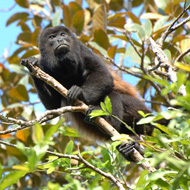
Low fibre diet leads to similar gut bacteria to humans, study finds
New research suggests monkeys in captivity lose much of their natural wild gut bacteria, and instead gain a new set of bacteria resembling that of humans.
The findings, published in the journal PNAS, may offer clues as to how modern western diets affect the microbiome, or gut bacteria, in humans.
Scientists from the University of Minnesota used DNA sequencing to study the gut microbes of red-shanked douc and mantled howler monkeys in several zoos across three continents. Their microbiomes were compared to those of their wild counterparts, as well as humans in the US and developing countries.
In the wild, researchers say each primate species has its own 'signature fingerprint of microbes'. But they found that those in captivity lost this distinctive bacteria and much of their native microbial diversity. Instead, the gut was dominated by species of Bacteroides and Prevotella - the same bacteria that dominates human guts.
And further study offered up a simple explanation - the monkeys in captivity were not eating enough plants.
Faecal samples were collected from a population of semi-captive red-shanked doucs living in a sanctuary. The animals received about half the variety of plants usually consumed by their wild counterparts. Researchers say their gut bacteria fell between those of wild and captive doucs, supporting the idea that eating less plants leads to a loss of microbial diversity.
The team also compared DNA sequenced from primate stool samples to plant genomes, which allowed them to measure the amount and diversity of plants consumed. Stools from wild primates were found to contain around 40 per cent plant material, while the captive primate stools contained almost none.
Dan Knights, computer science and engineering professor at Minnesota, commented: "We don't know for certain that these new modern human microbes are bad, but on the other hand, many studies are now showing that we evolved together with our resident microbes.
"If that is the case, then it is likely not beneficial to swap them for a totally different set."
Lack of fibre in western diets is thought to be harmful to the human microbiome and has been linked to numerous medical conditions - from autism to obesity. But because there are so many variables in humans, the way in which gut bacteria changes as societies become more modernised and westernised has remained a mystery.
Image © Leonardo C. Fleck (leonardofleck@yahoo.com.br)/Wikipedia/CC BY-SA 3.0


 The University of Glasgow is seeking participants for a new study into vet professionals nutrition-related knowledge, competence and decision-making.




