
Your data on MRCVSonline
The nature of the services provided by Vision Media means that we might obtain certain information about you.
Please read our Data Protection and Privacy Policy for details.

In addition, (with your consent) some parts of our website may store a 'cookie' in your browser for the purposes of
functionality or performance monitoring.
Click here to manage your settings.
If you would like to forward this story on to a friend, simply fill in the form below and click send.

Your friend's email:
Your email:
Your name:
 
 
Send Cancel

Discovery sheds light on how vertebrates see
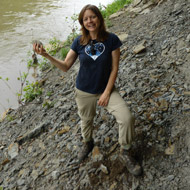
Professor Gabbot
Professor Sarah Gabbot led the research.
Researchers identify details in eyes of fossilised fish

A study of fossilised fish has quashed a long-standing theory on how vertebrates see.

After million's of years of degeneration, today's hagfish are completely blind. Research published in the journal Proceedings of the Royal Society B, however, suggests that ancient hagfish had good vision.

In the study, researchers analysed detail in the eyes of 300-million-year-old lamprey and hagfish fossils.

Using a high-powered microscope, they found that fossil retina is composed of minute structures called melanosomes. These are the same structures that occur in human eyes and prevent stray light bouncing around in the eye, allowing us to form a clear image.

This is the first time that such detail in fossils has been revealed. Before now it was thought that such anatomical details could not be preserved.

Professor Sarah Gabbot, who led the research, explains: “To date models of vertebrate eye evolution focus only on living animals and the blind and ‘rudimentary’ hagfish eye was held-up as critical evidence of an intermediate stage in eye evolution.

"Living hagfish eyes appeared to sit between the simple light sensitive eye ‘spots’ of non-vertebrates and the sophisticated camera-style eyes of lampreys and most other vertebrates.”

Detail observed in the hagfish fossil suggest it had a functional visual system. This means that the vision of living hagfish has been lost through millions of years of evolution, and the animal is therefore not as primitively simple as researchers first thought.

Professor Gabbot says that she will now inspect the eyes of other ancient vertebrate fossils to see if it is possible to build a picture of the sequence of events that took place in early vertebrate eye evolution.


 

Become a member or log in to add this story to your CPD history

Defra shares new Sanitary and Phytosanitary guidance

News Story 1
 Defra has published guidance for the vet sector ahead of a proposed UK-EU Sanitary and Phytosanitary agreement.


The agreement, which will change the movement and trade of animals and related products, could see reductions in checks, paperwork and certification. As well as describing regulatory developments, the advice highlights the importance of animal ID, registration and traceability in disease control and other compliance arrangements.

The guidance can be found here. More detail is expected as negotiations progress. 

Click here for more...
News Shorts
BSAVA publishes fifth Manual of Canine and Feline Neurology

The BSAVA has published the fifth edition of its BSAVA Manual of Canine and Feline Neurology.

The new edition has been reviewed and updated, including new developments in diagnostics, therapeutic approaches and clinical decision-making. It is structured to support clinicians through diagnosis, treatment and long-term management.

The guide features five new chapters covering acute myelopathies, chronic myelopathies, emergency protocols, neurotoxicology and neuro-oncology.

It also includes over 100 videos, including demonstrations of neurological examinations, clinical presentations and diagnostic procedures.

Nicola Lloyd, publishing manager, said: "Whether you're a general practitioner seeking practical guidance, or a specialist aiming to refine your expertise, this edition remains an indispensable reference for anyone involved in the care of neurologically compromised dogs and cats."