


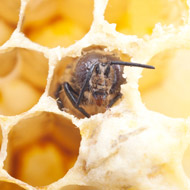
Finding suggests Deformed Wing Virus is manmade
A deadly disease which is decimating global bee populations is driven by the global trade in honeybees, according to a study led by the University of Exeter and UC Berkeley.
Research published in the journal Science found that the European honeybee Apis Mellifera is the source of cases of the Deformed Wing Virus infecting hives worldwide.
The finding suggests the pandemic is manmade rather than natural, with human trade and transportation of bees for crop pollination driving the spread.
Caused by the parasitic varroa mite, Deformed Wing Virus has wiped out millions of honeybees over recent decades. Infection of the mite is a double-blow to colonies, as varroa feed on bee larvae while the Deformed Wing Virus kills off the bees.
“This is the first study to conclude that Europe is the backbone of the global spread of the bee killing combination of Deformed Wing Virus and Varroa,” said lead author Dr Lena Wilfert.
“This demonstrates that the spread of this combination is largely manmade - if the spread was naturally occurring, we would expect to see transmission between countries that are close to each other, but we found that, for example, the New Zealand virus population originated in Europe.”
Dr Wilfert believes the finding ‘significantly strengthens’ the theory that humans are responsible for the spread of the disease.
“We must now maintain strict limits on the movement of bees, whether they are known to carry Varroa or not,” she advises. “It’s also really important that beekeepers at all levels take steps to control Varroa in their hives, as this viral disease can also affect wild pollinators.”
In the study, researchers analysed sequence data of Deformed Wing Virus samples across the globe from honeybees and Varroa mite. They used the information to reconstruct the spread of Deformed Wing Virus and found that the epidemic largely spread from Europe to North America, Australia and New Zealand.
The team also looked at samples from other species suspected of transmitting the disease, including different species of honeybee, mite and bumblebees, but concluded that the European honeybee was the key transmitter.


 Eligible members of BEVA will be able to vote for their Council team until Monday, 17 August 2026. Members will have received an election email on 17 July.



