


Walking patterns 'could predict disease spread'
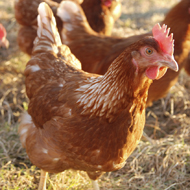
Dr Rao hopes farmers will one day be able to easily translate walking patterns to identify 'high risk' pens.
New research on the way chickens walk could one day help farmers to protect their flocks from disease.
Scientists have developed a mathematical model that plots the walking patterns of chickens around their pens. Using this grid, it may be possible predict the likelihood of disease spread by showing how many times/ways chickens cross each others' paths.
Researchers believe the model could be adapted for almost any farm animal.
"We want to know if we can predict the infectivity level of a particular pen from how the birds are moving," said Dr Arni Srinivasa Rao, a mathematical modeller at Georgia Regents University.
Whilst farmers would generally isolate any sick chickens they detect, individual inspection of animals is likely to be unfeasible on large poultry farms. Individual and even random testing is costly and time consuming.
Dr Rao hopes that farmers will one day be able to install cameras in their pens and translate walking patterns to identify 'high risk' pens, so that sick birds can be culled and others treated.
Working with Drs Fiona Tomley and Damer Blake at the RVC, he studied chicken pens in both the UK and India.
They looked at how often the animals ate and drank, how long they spent moving and resting, how far they moved, how often and where they defecated and the paths they followed to get food and drink.
Unsurprisingly, they found lots of opportunity for disease spread. Chickens keep walking while they defecate, often walking through their own faeces and that of other chickens. When they peck the ground, they can get faeces on their beaks, which is then spread to the water when they drink.
Dr Rao noted their distinct walking patterns, which usually involve moving diagonally across the pen or crisscrossing. Others tend to be more sedentary, mainly roosting by food and water.
Next, the research team plans to take the walking model back to the pen to see if it can be used to accurately predict a particular infection that costs US poultry farmers billions of pounds every year.
Eimeria spreads quickly and easily among farm animals, attacking the lining of the intestines and causing chronic diarrhoea, weakness and weight loss in about 3 per cent of chickens.
Dr Rao wants to help farmers predict how quickly that small percentage could reach 100 per cent in a particular chicken pen.
The study has been published in Mathematical Methods in the Applied Sciences


 Defra has published guidance for the vet sector ahead of a proposed UK-EU Sanitary and Phytosanitary agreement.



