
Your data on MRCVSonline
The nature of the services provided by Vision Media means that we might obtain certain information about you.
Please read our Data Protection and Privacy Policy for details.

In addition, (with your consent) some parts of our website may store a 'cookie' in your browser for the purposes of
functionality or performance monitoring.
Click here to manage your settings.
If you would like to forward this story on to a friend, simply fill in the form below and click send.

Your friend's email:
Your email:
Your name:
 
 
Send Cancel

Farmers 'unsure' of antibiotics best practice
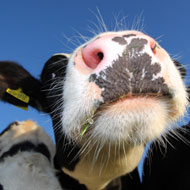
cow
Traditionally, drying-off practices among many dairy farmers have involved the blanket use of antibiotics.
Survey: 68 per cent unfamiliar with selective dry cow therapy

Dairy farmers may be unsure of best practice when it comes to antibiotics, a new survey suggests.

More than 200 farmers took part in a study by Farmers Weekly and animal health company Zoetis. Of these, only 68 per cent had heard of selective dry cow therapy.

From 1 October, all of Arla's producers will be required to use selective dry cow therapy, having discussed and agreed on the use of antibiotics with their vet. This is part of Arla's quality-assurance programme.

Traditionally, drying-off practices among many dairy farmers have involved the blanket use of antibiotics across all cows, to prevent and treat any new infections that develop during the dry period.

Now, amid concerns over antibiotic resistance, farmers are being urged to target their use of antibiotics.

Research also shows the use of narrow-spectrum antibiotics in low cell count cows could increase the risk of mastitis in the following lactation.

Of those farmers who had heard of selective dry cow therapy, 30 per cent were positive about it, saying they were practising it, thought it was progressive, or would make things better and cheaper.

Meanwhile, 32 per cent had concerns it would take more time, was risky, or could lead to an increase in cell counts.

Other key findings
  • 78 per cent are using an internal teal sealant.
  • 33 per cent said maintaining cleanliness at drying off is the biggest challenge.
  • 39 per cent said they choose different antibiotics for different cases in consultation with their vets.
  • 82 per cent said they are trying to adopt better hygiene to reduce antibiotics usage.


Mastitis expert Andrew Bradley, however, said he believes there may be some confusion over mastitis testing. Nearly a quarter (73 per cent) of farmers said they identify mastitis bacteria causing infection.

“I suspect that of the 73 per cent who claim to be testing for mastitis bacteria, many will be basing their results on bulk tank culture, which is not identifying mastitis bacteria," said Mr Bradley, who is director of Quality Milk Management Services.
“There is a huge misconception that if you do a bulk milk tank PCR it can tell you what mastitis-causing bacteria are present – this is complete nonsense. The vast amount of bacteria in a bulk tank is from the environment."

For the full results, visit: http://www.fwi.co.uk/livestock/exclusive-survey-results-use-of-antibiotics-on-UK-dairy-farms.htm

Become a member or log in to add this story to your CPD history

Equine Disease Surveillance report released for Q4 2025

News Story 1
 The latest Equine Disease Surveillance report has been released, with details on equine disease from Q4 of 2025.

The report, produced by Equine Infectious Disease Surveillance, includes advice on rule changes for equine influenza vaccination.

Statistics and maps detail recent outbreaks of equine herpes virus, equine influenza, equine strangles and equine grass sickness. A series of laboratory reports provides data on virology, bacteriology, parasitology and toxicosis.

This issue also features a case study of orthoflavivus-associated neurological disease in a horse in the UK. 

Click here for more...
News Shorts
NSA webinar explores sheep tailing and castration

The National Sheep Association (NSA) is to host a free webinar on the castration and tail docking of lambs.

The webinar, 'Understanding the tailing and castration consultation: A guide for sheep farmers', will be hosted online on Monday, 2 March 2026 at 7.30pm.

It comes during a government consultation into the methods used for these procedures. Farmers are encouraged to engage before the consultation period closes on Monday, 9 March 2026.

The webinar offers clear and actionable guidance to support farmers to contribute meaningfully to the consultation and prepare for potential changes.

On the panel will be former SVS president Kate Hovers, farmer and vet Ann Van Eetvelt and SRUC professor in Animal Health and Veterinary Sciences Cathy Dwyer. Each panel member will utilise their own specialism and expertise to evaluate risks and outcomes to sheep farming.

Find out more about the webinar on the NSA website.

