


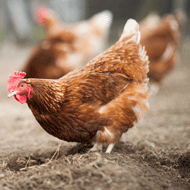
Trials with livestock prove successful
Scientists in the United States have stumbled upon an unusual way to protect livestock from infection without the use of antibiotics - feeding them eggs.
The discovery was made in 2011 by Mark Cook and Jordan Sand from the University of Wisconsin-Madison during a study of runaway inflammation in chickens. The eggs contain antibodies, which help keep an animal's immune system active to fight of disease.
Initial trials with thousands of chickens and hundreds of cattle have been successful, demonstrating that antibody-laden eggs can protect the animals from disease.
The scientists vaccinate laying hens with pieces of IL-10 (a protein that quiets the immune system) so the chickens produce antibodies against foreign protein - similar to how a flu vaccine creates immunity. The antibodies are concentrated in the yolk of their eggs.
When a cow or chicken eats some of the egg, the antibodies inactivate IL-10 in the gut, causing the immune system to fight infection more effectively.
Working with a local poultry farmer, the scientists tested the antibodies with 300,000 chickens. Fed with antibody-filled eggs, the chickens fared just as well as those given traditional antibiotics.
To see if the method would work in other animals, they recruited Dan Schaefer, professor of animal sciences at UW-Madison, and Sheila McGuirk, a professor of large animal medicine at the School of Veterinary Medicine, to oversee experiments with calves, steers and lambs.
They found that calves fed the antibiotics required half as many antibiotics as those that did not. Most surprisingly was that in some experiments, antibodies in the gut reduced respiratory disease by as much as half or two-thirds.
"We did not expect to see the respiratory benefit," McGuirk said.
Cook and Sand have obtained a patent and a £100,000 grant from the Wisconian Alumni Research Foundation to commercialise their research through their new company, Ab E Discovery.
Ongoing trials will study the link between the gut and lung, as well as iron out kinks in antibody production and dosage.

 The BSAVA has opened submissions for the BSAVA Clinical Research Abstracts 2026.



