


Always consider hyperthyroidism and CKD together
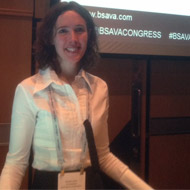
Dr Rosanne Jepson from the RVC spoke at BSAVA Congress 2015.
Dr Rosanne Jepson from the RVC, London, speaking at a BSAVA Congress session on concurrent disease, tackled the subject of hyperthyroidism and chronic kidney disease.
She began by noting that both CKD and hyperthyroidism in cats have a median age of diagnosis of 12 years. "It is not surprising," she said, "that these two conditions can occur concurrently and complicate diagnosis."
A high proportion of azotaemic cats, that have been treated for hyperthyroidism, appear to have subsequent kidney damage as a consequence of hypertension. There is also a vasoconstrictive effect leading to tissue hypoxia and related renal pathology.
There is not much direct evidence of this link, but models suggest that it is not unreasonable to assume that when cats are diagnosed with hyperthyroidism they will also develop CKD. On the other hand, there are occasions when CKD can make the diagnosis of hyperthyroidism complicated.
There is some evidence that cats treated for hyperthyroidism have a reduced GFR and increased creatinine levels; and over-treatment can lead to iatrogenic hypothyroidism.
Cats that are azotaemic at the time of diagnosis of hyperthyroidism have a reduced life expectancy.
Dr Jepson warned that Free T4 may be detected in up to 20 per cent of cats that have non-thyroidal disease, so this test should always be carried out in conjunction with other tests, including those for renal function. In difficult cases, it is worth running a TSH test, T3 suppression and thyroid scintigraphy tests to try and confirm the diagnosis.
It is also important to monitor for hypothyroidism in azotaemic cats following hyperthyroidism therapy in case medical therapy needs modification. Dr Jepson warned clinicians to be cautious not to micromanage cases and thus make too many changes to therapy too frequently.
The aim is to manage therapy to maintain a healthy appetite and normal body weight. She urged veterinary professionals to use their clinical judgement in these cases and not rely solely on biochemical tests.


 The University of Glasgow is seeking participants for a new study into vet professionals nutrition-related knowledge, competence and decision-making.




