


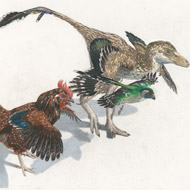
Arrival of birds some 150 million years ago was a gradual process
A comprehensive family tree of meat-eating dinosaurs is enabling scientists at the University of Edinburgh to discover key details about how birds evolved from them.
The study has revealed that the familiar anatomical features of birds, such as wings, feathers and wishbones, all first evolved gradually in their dinosaur ancestors millions of years ago.
However, an evolutionary explosion began once a fully functioning bird body shape was complete - causing a rapid increase in the rate at which birds evolved. Eventually this led to the thousands of avian species that we know today.
To create the family tree, the researchers examined the anatomical make-up of over 850 body features in 150 extinct species. They then used statistical techniques to analyse their findings and assemble a detailed family tree.
The researchers say that, based on their findings from fossil records, the arrival of birds some 150 million years ago was a gradual process, as some dinosaurs became ever-more bird-like over time. For this reason, it is difficult for scientists to draw a dividing line on the family tree between dinosaurs and birds.
The findings, published in the journal Current Biology, support a controversial theory proposed in the 1940s - that a surge in evolution can follow the emergence of new body shapes in groups of species.
Dr Steve Brusatte, who led the study, said: "There was no moment in time when a dinosaur became a bird, and there is no single missing link between them. What we think of as the classic bird skeleton was pieced together gradually over tens of millions of years. Once it came together fully, it unlocked great evolutionary potential that allowed birds to evolve at a super-charged rate."
Dr Graeme Lloyd, from the University of Oxford, said: "Our study adds to a growing number of works that approach this problem from different angles, but all seem to confirm that the origin of birds was a truly special event in Earth history. It is particularly cool that it is evidence from the fossil record that shows how an oddball offshoot of the dinosaurs paved the way for the spectacular variety of grid species we see today."
Image (C) University of Edinburgh/Jason Brougham


 A nationwide roadshow offering free, personalised parasite risk assessments and flea and tick checks will be visiting popular dog events across the UK.



