


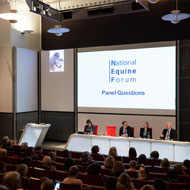
The event will explore artificial intelligence and the modern pre-purchase examination.
Challenges in equine health, management, welfare and environmental responsibility are set to go under the spotlight at this year’s National Equine Forum (NEF).
The event will take place in London on Thursday, 5 March 2026, with talks from leading veterinary professionals, a government minister, and senior industry figures. A free live stream will be made available for those who are unable to attend on the day.
NEF chair Tim Brigstocke said: “At a time when regulatory decisions, environmental changes and technological innovation are having an increasing impact on the equestrian sector, the National Equine Forum provides a vital bridge between government, the veterinary profession and those working at the sharp end.
“Our outstanding lineup of speakers will be addressing some of the most pertinent critical issues, grounded in evidence and informed by practical experience.”
Now in its 34th year, the NEF will include a discussion on the modern Pre-Purchase examination with Dr Mark Georgetti, Dr Lucy Grieve, Dr Sam Cutts and Julia Martin. The panel will explore where vettings can go wrong, how expectations and responsibilities have shifted, and what this means for the horse industry.
RCVS Professor Tim Parkin will chair an exploration into the rapidly growing role of AI in equine health and welfare, while Sarah Jenkins, editor-in-chief of Horse & Hound, will lead a series of special interest topics. Among these include the social value of equestrianism and an update on proposed fireworks legislation.
There will also be a panel discussion chaired by Dr Richard Newton, Director of Epidemiology & Disease Surveillance, University of Cambridge, who will lead a series of equine health risk updates.
The forum will culminate in the Memorial Lecture, which will take the form of an interview with Professor Chris Riggs, director, HKJC Equine Welfare Research foundation and chief advisor. The winner of the Sir Colin Spedding Award 2026 will then be announced.
For more information and to register for the event, visit the National Equine Forum website.
Image (C) NEF.


 Companies marketing medicines for small pets exempt from authorisation must submit their annual return to the Veterinary Medicines Directorate (VMD) by 30 November 2026.



