


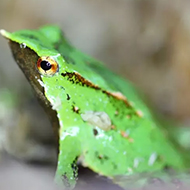
Study reveals how a deadly fungus is silently devastating the Darwin’s frog.
A new study has revealed how ‘silent’ outbreaks of a deadly fungus are rapidly wiping out the endangered Southern Darwin’s frog in Chile’s remote Parque Tantauco.
The study, published in Nature Ecology and Evolution, shows how the devastating chytrid fungus not only spreads through water – as was previously understood – but also through close contact with other frogs on land.
This means Darwin's frogs living in forest patches near infected neighbours face the greatest risk. These small, undetected epidemics have population declines of up to 90 per cent.
In the study, researchers used a decade of data from some 1,500 frogs to show, for the first time, how the fungus-caused disease, chytridiomycosis, spreads in a species that spends its entire life on land.
Dr Andrés Valenzuela-Sánchez, Research Fellow at ZSL’s Institute of Zoology and lead author of the study, said: “The global spread of chytrid fungus is one of the biggest threats for amphibians – of an apocalyptic scale – but we still have a chance to turn things around.
“Darwin’s frogs are a unique part of South America’s rich biodiversity, and uncovering these hidden dynamics gives us the tools to monitor and manage the fungus as effectively as possible in our fight to protect this precious frog and other amphibians across the world.”
When chytrid fungus was first detected in 2023, the Zoological Society of London (ZSL) and Ranita de Darwin and Parque Tantauco launched a rescue mission to establish a protected breeding population of the threatened frogs.
Fifty-three chytrid-free frogs were transported 13,000km by boat, car and plane in specially-designed climate-controlled boxes to London Zoo. The Zoo’s team care for them in bio secure habitats, and since the frogs’ arrival, over 30 rice-grain sized froglets have already been born.
Dr Benjamin Tapley, ZSL’s curator of amphibians and reptiles, explained: “Conservation zoos are lifelines for wildlife, including the hundreds of amphibians whose futures are threatened by this deadly fungus.
"They allow us conservationists to boost numbers and raising awareness while we use science to develop strategies to tackle this pandemic. Every insight we get into the disease brings us one step closer to releasing zoo-bred Darwin’s frogs back into the forests of Chile and Argentina.”
Image (C) ZSL.


 Companies marketing medicines for small pets exempt from authorisation must submit their annual return to the Veterinary Medicines Directorate (VMD) by 30 November 2026.



