


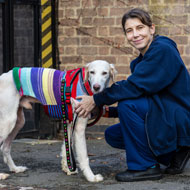
Saluki Salty would cry all night in the hospital kennels.
A veterinary care assistant, who nursed an RSPCA rescue dog back to health, has spoken how she fell in love with her ‘perfect patient’ – so much so that she ended up adopting him.
Celine Garcia-Leoni, from the RSPCA’s Finsbury Park Animal Hospital, first met Saluki Salty in October last year when he was found with 25 other dogs all living in unsuitable conditions.
Salty’s coat was filthy, covered in urine stains and he had patches of missing fur. He walked with a limp and preferred to lie down rather than put weight in his injured leg.
X-rays revealed that salty required cruciate ligament surgery to stabilise the joint – a painstaking operating that took vets almost three hours. He also had a large tear in his meniscus, part of which had to be removed.
Salty was a model patient and, thankfully, the surgery was a success. However, he was extremely upset and unhappy in kennels. Staff at the centre would often report he would cry and howl through the night because he wanted to be near people.
Fearing his distress could lead to him hurting himself and impede his recovery, staff agreed that he should go into foster care over December. That’s when veterinary care assistant Celine offered to take him back to her family home in London - and the rest, they say, is history!
Celine said: “The plan was originally to have him over Christmas and then take him back in for January to see how his leg was healing and then we could look to rehome him. In the meantime, he would get used to being in a home as well - but basically what tends to happen with lots of foster dogs - is they end up staying for good!
“This was exactly what happened to me and Salty! He just fitted in so well with the family and my other dog and he just immediately became part of the furniture - he literally is a little lamb and just a real angel - a perfect boy.”
Salty continued his recovery with Celina, returning to Finsbury Park in January for more x-rays, which revealed that everything was healing well. While he will never be 100 per cent, he can now walk and run without pain.
Celina continued: “I have been guided by the vets with his rehabilitation as it’s a long road to recovery and takes around six months to see the real improvements such as the build-up of his muscles.
“Everything has to be taken so slowly and we had to ensure he didn’t over exercise - he continued to have pain relief and physiotherapy.
“He’s just been the perfect boy - everyone fell in love with him with such a gentle temperament - he didn’t like the cone of shame - but because he was such a good boy and didn’t touch his bandages, we were able to remove it - much to his delight.
“I guess the only good thing about his past is that because he was at a location with 25 other dogs, he does have good dog social skills and he knows how to read them - so that’s the one silver lining of his situation.
“We will never fully know his history - as despite the inspectors leaving an abandonment notice to find his owners - no one ever came forward.”
Image (C) RSPCA.


 Companies marketing medicines for small pets exempt from authorisation must submit their annual return to the Veterinary Medicines Directorate (VMD) by 30 November 2026.



