


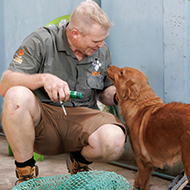
The charity vaccinated over 220,000 dogs during a two-week campaign.
UK veterinary charity Worldwide Veterinary Service has completed a record-breaking rabies drive of dogs in Cambodia, vaccinating more than 221,000 dogs during a two-week campaign.
The project forms part of the charity’s Mission Rabies campaign in collaboration with the Cambodian government. It comprised of 343 vaccination teams, working across the Provinces of Phnom Penh, Kandal, and Battambang.
On a single day alone, the charity vaccinated an incredible 10,000 dogs — the highest ever recorded on any of its global campaigns. A mobile treatment team was also deployed during the campaign, providing veterinary assistance when volunteers identified animals in need of urgent care.
Luke Gamble, founder and CEO of Mission Rabies/WVS said: “Vaccinating over 220,000 dogs against this deadly disease during this year’s two week campaign is a massive achievement. This isn’t easy work – it means going door-to-door, through entire provinces, in intense heat, working from dawn until dusk to reach every dog we can.
“Our NUVA teams are nothing short of inspiring – that’s why I’m so incredibly grateful to our dedicated partners, our amazing volunteers, and the tireless crew on the ground who make this possible”
He continued: “It has been incredibly uplifting to see that year three into this campaign, we now have the support of the communities where we work. Families bringing their dogs forward for vaccination. This is what true collaboration looks like. This is how we beat rabies. And together, we can stop people and animals dying from this horrific disease – once and for all.”
British nurse Robyn Thomson, whose mother made headlines when she passed away from rabies earlier this year, played a crucial role in the campaign.
Robyn and her husband Andrew worked alongside over 750 people participating in the campaign. More than 50 international volunteers and over 250 Cambodian veterinary students also helped to form vaccination teams on the ground.
Dr Amy Nicole Lewis, international project manager at WVS, said: “We collaborated with Royal University of Agriculture (RUA) and National Institute of Agriculture (NIA) for the 3rd year running. The participation of veterinary students is such a wonderful addition to this project. We know now that every student who graduates as a vet in Cambodia will have a knowledge of rabies and how to prevent it.”
Image (C) Worldwide Veterinary Service.


 Companies marketing medicines for small pets exempt from authorisation must submit their annual return to the Veterinary Medicines Directorate (VMD) by 30 November 2026.



