


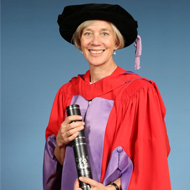
Leading figures in science and veterinary medicine have been honoured.
The Royal Veterinary College has awarded Honorary Degrees to two eminent leaders in science and veterinary medicine.
Professor Dame Angela McLean and Professor Gary England received their degrees at the RVC graduation ceremony in 2025. The pair were honoured for ‘significant contributions to research, education and public service and a profound impact in the veterinary and scientific communities’.
RVC president and principal Stuart Reid CBE, who conferred the degrees, said: “Honorary degrees are a means by which we at the RVC can recognise and promote the excellence of outstanding members of our community.
“We are now fortunate to be able to count both of our honourees amongst our alumni and to hold them up as role models for future generations of our student body. To both Angela and Gary, I offer our congratulations and, more importantly, our thanks.”
Dame Angela has served as the chief scientific adviser to the government since 2023. She was recognised for her outstanding leadership and innovative applications of mathematical models to aid understanding of the evolution and spread of infectious agents.
She was an elected Fellow of the Royal Society and the Gabor Medal and Weldon Memorial Prize. A renowned academic, she has used her expertise in this area to formulate evidence-led public policy. In 2018, she was awarded her Damehood for services to mathematical biology and to scientific advice to government.
Professor England is Dean of the School of Veterinary Medicine and Science at the University of Nottingham. He was recognised for his pioneering contributions to veterinary clinical practice, education and research, particularly in the field of small animal reproduction.
He has held various leadership roles at Guide Dogs UK and led ground-breaking research, including the first successful in-vitro fertilisation in dogs and studies linking environmental chemical exposure to declining fertility.
Professor England has played a central role in strengthening veterinary education in the UK, founding multiple organisations focused on postgraduate training development, and establishing the UK’s first new veterinary school in decades at the University of Nottingham.
Image (C) RVC.


 Companies marketing medicines for small pets exempt from authorisation must submit their annual return to the Veterinary Medicines Directorate (VMD) by 30 November 2026.



