


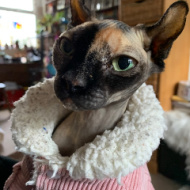
Corneoconjunctival transposition performed by ophthalmology specialists.
A sphynx cat named Felicity has had her sight saved following a complex surgery at Davies Veterinary Specialists in Hertfordshire.
The four-year-old cat was brought into her local veterinary surgery when her owners noticed her squinting her right eye.
Felicity's veterinary surgeon was concerned about the appearance of her eye, and referred her to the ophthalmology department at Davies.
Davies ophthalmology team diagnosed Felicity with a deep corneal sequestrum, an area of dead cornea, which needed surgery to save her vision.
Adam Margetts, ophthalmology resident, explained: “Felicity’s right eye had a corneal sequestrum with evidence of "corneal melting" at its periphery which required surgical intervention in order to prevent further deterioration.”
The ophthalmology team placed Felicity under general anaesthetic, and then removed the sequestrum and diseased cornea.
Following this, a graft using her healthy cornea was used to stabilise the deep corneal defect, and hair-thin dissolvable sutures attached the graft to the cornea.
The complex corneal graft was a success, and Felicity was discharged the day after her surgery.
Adam continued: “We are delighted that Felicity has regained full and pain-free use of her right eye.
“Her owner is aware that the formation of new ulcers and corneal sequestra remain possible in the future, but with regular check-ups we can stay a step ahead and treat early if required.”
Image (C) Davies Veterinary Specialists


 Companies marketing medicines for small pets exempt from authorisation must submit their annual return to the Veterinary Medicines Directorate (VMD) by 30 November 2026.



