


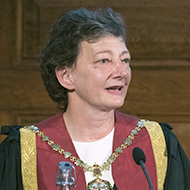
Dr Melissa Donald was invested at the College's AGM.
New RCVS president Dr Melissa Donald has pledged to spend much of the year listening to veterinary professionals and communities across the UK to better understand the issues affecting them.
Dr Donald, who was sworn in as president at the College's AGM on Friday (8 July), graduated from the University of Glasgow veterinary school in 1987. She launched her career as a food animal intern at Iowa State University in the US before moving into mixed practice in Ayrshire.
The following 25 years saw Dr Donald and her husband Kenny develop Oaks Veterinary Centre into a small animal practice focussing on dentistry.
First elected to Council in 2016, Dr Donald was re-elected in 2020 and has served on the Education and Finance and Resources Committees. Most recently, she served as chair of the Standards Committee, leading the development of the proposed guidance on 'under care' and out-of-hours emergency care.
In her first address as president of the RCVS, Melissa described her sense of community with fellow vets as a relatively small but prominent profession that punches above its weight and how she intended to strengthen this.
She said: “When I looked this up in June, there were over 300,000 doctors registered with the General Medical Council. We, the veterinary profession, have around 30,000 registered with the RCVS to look after farmed, pet, lab animal, exotic, zoo and wildlife species. In other words, all animals EXCEPT the human, and we protect humans too, with public health work!
“Even excluding farmed fish, over 300 million animals are being cared for by 30,000 professional veterinary surgeons and their teams. That is the scale of our small but mighty community. Being part of a community doesn’t mean we all have to be clones of each other, but a group that can agree to disagree, and is there for each other in times of need.”
Melissa continued: “We are part of many different community circles: family, school, online, college, work and hobbies to name a few, and many interconnect with each other just like a massive Venn diagram. Some people wish to keep the circles separate, but to me, they are all intrinsically connected, and we are the sum of each part of our lives, and that is what makes us who we are. Of course, this doesn’t mean we have to be everything to everyone 24/7, as ‘me time’ is precious, and finding that space to breathe is what helps us feel grounded.
“With this close proximity to each other, communication is key. My mother has offered me many wise words over the years, most frequently being ‘engage brain before opening mouth’ but just as important as speaking is listening and actually hearing what is being said. So, over this year I will try to get out and about as much as possible, focus on hearing what our community is saying and engage in many conversations as we work together. After all, I am the ‘nomadic’ president, of no fixed abode, at least until we all get to move into the new headquarters in Hardwick Street.”
Image (C) RCVS.


 Companies marketing medicines for small pets exempt from authorisation must submit their annual return to the Veterinary Medicines Directorate (VMD) by 30 November 2026.



