


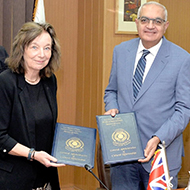
The College has signed a memorandum of understanding with Mansoura University.
The Royal Veterinary College (RVC) and Mansoura University in Egypt have signed a memorandum of understanding (MOU) to collaborate on a transnational partnership in veterinary medicine.
The partnership is set to support students from Egypt, the Middle East and North Africa (MENA) with the development of a new veterinary degree. Adapting the RVC’s approach to veterinary medical teaching, the new programme will be the first of its kind in Egypt and aims to set the standard for veterinary training in the region.
As part of the arrangement, a team of senior professors and lecturers from the RVC recently met with the President of Mansoura University for an initial site visit and set out the broad aims for the partnership. Among them included: Nina Davies, director of access and international engagement; Professor Jill Maddison, professor of general practice; and Dr Michael Hewetson, senior lecturer in equine medicine.
The team met with the clinical and teaching faculty and current veterinary medicine students. They also toured the facilities of the Faculty of Veterinary Medicine, several of Mansoura University’s medical and technological institutes, and its new fossil museum, the first of its kind in Egypt.
RVC president and principal, Professor Stuart Reid, commented: “Now, more than ever, veterinarians are needed to improve the health and welfare of both animals and humans around the world.
"The Royal Veterinary College welcomes the opportunity of supporting our colleagues at Mansoura University as they develop a new veterinary programme for Egypt and the MENA region. The signing of this MOU marks the start of what I am sure will be a productive partnership between our two universities.”
Mansoura University president, Professor Dr Ashraf Abdel Basset, said: “We are at a critical scientific and academic juncture in which Egyptian universities must collaborate with highly ranked European universities, including the Royal Veterinary College, to help improve educational performance and positively reflect on the Arab Republic of Egypt’s higher education system.
"This partnership with the Royal Veterinary College is an important milestone for Mansoura University and I look forward to seeing our future generations learn about veterinary sciences from global leaders in this field.”
Image (C) RVC.


 Companies marketing medicines for small pets exempt from authorisation must submit their annual return to the Veterinary Medicines Directorate (VMD) by 30 November 2026.



