
Your data on MRCVSonline
The nature of the services provided by Vision Media means that we might obtain certain information about you.
Please read our Data Protection and Privacy Policy for details.

In addition, (with your consent) some parts of our website may store a 'cookie' in your browser for the purposes of
functionality or performance monitoring.
Click here to manage your settings.
If you would like to forward this story on to a friend, simply fill in the form below and click send.

Your friend's email:
Your email:
Your name:
 
 
Send Cancel

Edinburgh Zoo welcomes inquisitive otter pair
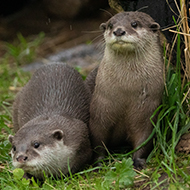
Barry and Luna are enjoying exploring their new home.
Barry and Luna are settling in well to their new enclosure. 

The Royal Zoological Society of Scotland has welcomed the arrival of two Asian small-clawed otters to Edinburgh Zoo.

Keepers at the wildlife conservation charity say the otters, named Barry and Luna, are becoming more confident every day and enjoy exploring their new enclosure.

Senior carnivore keeper Andrew Laing, said: “Barry and Luna are settling well into their new home and are already very bonded.  

“They were quite shy when they first arrived last month and still like to spend a lot of their morning in their underground holts but in the afternoon, they come out for a dip in their pool and a nosy at what our visitors are up to.

“Luna is the more confident of the two and you can tell her apart from Barry as she has a pink nose and he has a black nose.”

One of the world's smallest otters, the Asian small-clawed otter is listed as Vulnerable on the IUCN Red List. They are extremely dextrous and use their forepaws to feel for crustaceans and molluscs in mud, rock and vegetation.

The species is found in the wild throughout south-east Asia, the Philippines and Indonesia. In recent years, however, deforestation, agriculture and the overexploitation on prey have seen their populations plummet.

Become a member or log in to add this story to your CPD history

Equine Disease Surveillance report released for Q4 2025

News Story 1
 The latest Equine Disease Surveillance report has been released, with details on equine disease from Q4 of 2025.

The report, produced by Equine Infectious Disease Surveillance, includes advice on rule changes for equine influenza vaccination.

Statistics and maps detail recent outbreaks of equine herpes virus, equine influenza, equine strangles and equine grass sickness. A series of laboratory reports provides data on virology, bacteriology, parasitology and toxicosis.

This issue also features a case study of orthoflavivus-associated neurological disease in a horse in the UK. 

Click here for more...
News Shorts
Applications open for BEVA Back in the Saddle

The British Equine Veterinary Association (BEVA) has opened applications for its 'Back in the Saddle' coaching programme.

The online scheme offers structured group coaching for members wanting to reflect on their career path and regain clarity. Members may be returning to work after leave, uncertain about next steps or reassessing direction.

Attendees will benefit from impartial guidance and practical tools to support their professional development. Members are encouraged to take a 'proactive, future-focused approach' to their careers.

The sessions, taking place on Wednesdays from 7.30pm-9pm, are open to BEVA members with more than five years' experience. The first session takes place on Wednesday, 3 June 2026.

Applications will close on Wednesday, 27 May 2026.

