


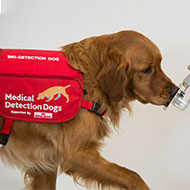
Charity launches first-ever national awareness campaign
Registered charity Medical Detection Dogs has launched its first-ever national campaign to raise awareness of its lifesaving work and raise vital funds.
From the 9th to the 15th February, schools, offices and local communities are being urged to ‘Paint the Town Red’ by holding red mufti days, selling red cupcakes and decorating their shopfronts in red.
Medical Detection Dogs use their incredible olfactory abilities to sniff-out human diseases such as malaria, cancer and Parkinson’s. Each bio-detection dog costs a staggering £29,000 to train.
Bio-detection dogs are also partnered with people who have life-threatening conditions, such as Type 1 diabetes or Addison's. The dogs are trained to detect the smallest of changes in their partner's personal odour, which is triggered by the disease, and alert a potentially life-threatening event.
Despite being at the helm of research into the fight against cancer, Medical Detection Dogs receives no government funding. Instead, the charity is fully reliant on the generosity of donations it receives from trusts and the public.
“By joining in with our Paint the Town Red week you will not only be celebrating love for Valentine’s Day but also raising funds and awareness of the work of our amazing dogs,” said Medical Detection Dogs community fundraiser, Carolyn Green.
“The diseases our Bio Detection Dogs are trained to detect affect every single one of us and they could be at the forefront of early diagnosis of cancer, Parkinson’s and other diseases and ultimately more lives being saved.
“The conditions our Medical Alert Assistance Dogs work with are extremely complex and often our clients have given up hope of leading a normal life for fear of falling ill at any moment. These wet-nosed knights in shining armour turn this around and save their lives in more ways than one.
“Our dogs will be wearing their own red coats with pride that week so please join them!”
For more information about the campaign and to order an fundraising pack, visit medicaldetectiondogs.org.uk or email fundraising@medicaldetectiondogs.org.uk
Image (C) Medical Detection Dogs.


 Companies marketing medicines for small pets exempt from authorisation must submit their annual return to the Veterinary Medicines Directorate (VMD) by 30 November 2026.



