
Your data on MRCVSonline
The nature of the services provided by Vision Media means that we might obtain certain information about you.
Please read our Data Protection and Privacy Policy for details.

In addition, (with your consent) some parts of our website may store a 'cookie' in your browser for the purposes of
functionality or performance monitoring.
Click here to manage your settings.
If you would like to forward this story on to a friend, simply fill in the form below and click send.

Your friend's email:
Your email:
Your name:
 
 
Send Cancel

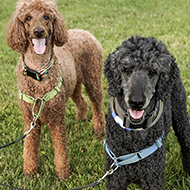
DNA testing schemes for standard poodles approved
Two new DNA testing schemes to combat progressive retinal atrophy (PRA) in the standard poodle have been approved by the Kennel Club.


Schemes designed to combat inherited eye disease

Two new DNA testing schemes to combat progressive retinal atrophy (PRA) in the standard poodle have been approved by the Kennel Club.


The schemes, prcd-PRA and PRA (rcd4), follow consultation with the Poodle Breed Council. With no current treatment for the disease, standard poodle breeders will be able to use the tests to screen their animals and factor this into their breeding programmes.


“The Kennel Club constantly reviews DNA testing schemes in conjunction with breed clubs to ensure that breeders are supported with resources which help them to make responsible breeding decisions,” explained Gary Johnson, Kennel Club breeder services manager. 


“DNA technology is making huge advances year upon year. It is very good news that standard poodle breeders are taking advantage of this technology which will be of huge benefit not only to current litters of the breed but future generations too.”


PRA is a well-recognised inherited condition to which several dog breeds are susceptible. The disease is defined by bilateral degeneration of the retina, causing progressive loss of vision resulting in total blindness.

Veterinary professionals wishing to find out which laboratories the Kennel Club can record results from, and which laboratories will send results direct to the Kennel Club, may refer to the worldwide DNA testing list.

Test results will be added to the dog’s registration details which will trigger the publication of the result in the next available Breed Records Supplement.

The result will appear on any new registration certificate issued for the dog and on the registration certificates of any future progeny of the dog, as well as on the Health Test Results Finder on the Kennel Club website.  

Become a member or log in to add this story to your CPD history

Animal Medicines Amnesty returns this November

News Story 1
 Veterinary practices are being urged to help owners safely dispose of any unused and expired pet medicines - not just antibiotics - during November's Animal Medicines Amnesty.


Organised by the Responsible Use of Medicines Alliance Companion Animal and Equine (RUMA CA&E), the initative is supported by a range of cross-sector organisations.

Practices are encouraged to use the campaign to engage the whole practice team and raise awareness of the safe disposal of medicines with clients. Learn how your practice can get involved at rumacae.org.uk 

Click here for more...
News Shorts
APHA launches free virtual work experience programme

The Animal and Plant Health Agency (APHA), in collaboration with Springpod, has launched a free virtual work experience programme, giving young people across the UK the chance to explore careers dedicated to protecting animal and plant health.

The on-demand programme offers a unique insight into career opportunities within APHA, showcasing how students can contribute to tackling some of the UK's most critical biosecurity and environmental challenges.

Designed for students aged 13 and over, the course includes more than 10 hours of engaging content featuring real-life industry insights, scenario-based challenges, and practical guidance on applying for jobs. To register for the course, visit the APHA website.
