
Your data on MRCVSonline
The nature of the services provided by Vision Media means that we might obtain certain information about you.
Please read our Data Protection and Privacy Policy for details.

In addition, (with your consent) some parts of our website may store a 'cookie' in your browser for the purposes of
functionality or performance monitoring.
Click here to manage your settings.
If you would like to forward this story on to a friend, simply fill in the form below and click send.

Your friend's email:
Your email:
Your name:
 
 
Send Cancel

Rats will ‘rescue’ trapped robot rats, study finds
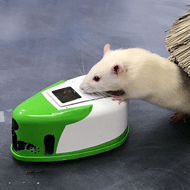
The robots were then trapped in different enclosures and rats had the opportunity to open the door to one or both enclosures, freeing the robots.
‘Helpful’ robots were more likely to be released from enclosure 

New research suggests rats can form social connections with robots and will even ‘rescue’ them if they become trapped.

Scientists introduced rats to two rat-sized robots, one of which was ‘helpful’ and engaged in rodent-like social behaviour, including following, mirroring, exploring and playing with toys. The other robot was mobile but displayed only minimal behaviours, such as moving backwards and forwards and side to side.

Each rat was trapped in an enclosure and released by the helpful robot three times, while the other robot performed random movements in the arena.

The robots were then trapped in different enclosures and rats had the opportunity to open the door to one or both enclosures, freeing the robots.

Findings published in Animal Behaviour and Cognition show that rats rescued at least one robot 76 per cent of the time. And they displayed a significant preference for rescuing the helpful robot, over the unhelpful robot.

Robots are increasingly used to monitor or participate in social interactions with animals in their own environment. However, it was not clear whether animals would form positive social connections with these robots.

This is the first study to suggest rats show pro-social behaviour towards artificial entities. 

Become a member or log in to add this story to your CPD history

Equine Disease Surveillance report released for Q4 2025

News Story 1
 The latest Equine Disease Surveillance report has been released, with details on equine disease from Q4 of 2025.

The report, produced by Equine Infectious Disease Surveillance, includes advice on rule changes for equine influenza vaccination.

Statistics and maps detail recent outbreaks of equine herpes virus, equine influenza, equine strangles and equine grass sickness. A series of laboratory reports provides data on virology, bacteriology, parasitology and toxicosis.

This issue also features a case study of orthoflavivus-associated neurological disease in a horse in the UK. 

Click here for more...
News Shorts
Applications open for BEVA Back in the Saddle

The British Equine Veterinary Association (BEVA) has opened applications for its 'Back in the Saddle' coaching programme.

The online scheme offers structured group coaching for members wanting to reflect on their career path and regain clarity. Members may be returning to work after leave, uncertain about next steps or reassessing direction.

Attendees will benefit from impartial guidance and practical tools to support their professional development. Members are encouraged to take a 'proactive, future-focused approach' to their careers.

The sessions, taking place on Wednesdays from 7.30pm-9pm, are open to BEVA members with more than five years' experience. The first session takes place on Wednesday, 3 June 2026.

Applications will close on Wednesday, 27 May 2026.

