


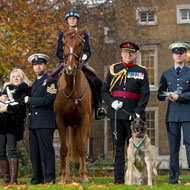
Armed forces gather to honour war animals
A ceremony to mark the 75th anniversary of the PDSA Dickin Medal has seen animals and humans from the armed forces gather together, to commemorate the actions of its recipients.
The special event at the Imperial War Museum, London, saw members of the RAF, Army and Royal Navy stand alongside a dog, pigeon, horse and cat - all wearing Dickin Medals.
Jan McLoughlin, PDSA director general, said: “Today we honour the animals who also serve: those noble creatures whose skill and courage have saved countless military and civilian lives. The face of armed conflict has changed beyond recognition over the last 75 years, yet we rely on these gallant animals as much as ever.”
The Dickin Medal was introduced by the charity’s founder, Maria Dickin CBE, who wanted to recognise the life-saving roles animals were playing in the war effort - both at home and on the Front Line.
In December 1943, messenger pigeon Winkie became the medal’s first recipient, alongside fellow RAF pigeons White Vision and Tyke.
Winkie was on board a Beaufort Bomber that came under enemy fire and ditched in the sea during a mission over Norway. Unable to radio their position, the stranded four-man crew released Winkie in an attempt to raise the alarm.
Despite being covered in oil and facing terrible weather conditions, she flew more than 120 miles home, where her owner passed the message to RAF Leuchars in Fife and a successful rescue operation was launched within 15 minutes. Her actions saved the lives of the crew.
Since this inaugural medal was presented, 71 incredible animals have been honoured by the charity, including 34 dogs, 32 pigeons, four horses and one cat. An honorary medal was also bestowed on the war horse Warrior in 2014, on behalf of all 16 million animals that served in World War One.
Colonel Neil Smith QHVS, chief veterinary and remount officer, said: “Animals serving in the Armed Forces make a massive difference to the lives of so many. Not just those men and women they serve alongside, but the civilians whose lives our military are protecting. They fulfil a role humans cannot replicate.
“The PDSA Dickin Medal is a fitting tribute to their extraordinary contributions.”
Image © PDSA


 Companies marketing medicines for small pets exempt from authorisation must submit their annual return to the Veterinary Medicines Directorate (VMD) by 30 November 2026.



