


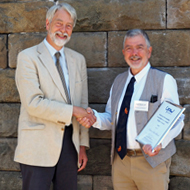
Prof Paul Flecknell recognised for improving the welfare of laboratory animals
A leading expert in laboratory animal science and welfare has received a top honour in recognition of his achievements.
Professor Paul Flecknell received the Universities Federation for Animal Welfare (UFAW) Medal for Outstanding Contributions to Animal Welfare Science at a special ceremony in Newcastle today (28 June).
UFAW CEO Dr Robert Hubrecht, who presented the award, said: “Professor Flecknell’s exceptional contributions have been at many levels - scientific, practical, translational, educational and academic leadership. He is an outstanding winner of the 2018 UFAW medal.”
Prof Flecknell is a professor of laboratory animal science and director of comparative biology centre at Newcastle University. His work has helped scientists across the world understand the pain which may be inflicted on animals by their research and how this can be managed without reducing the scientific value.
Besides publishing more than 180 books, chapters and peer-reviewed papers, Prof Flecknell has also played a hugely influential role on many committees, societies, funding bodies and journals concerned with laboratory animal welfare science. His book Laboratory Animal Anaesthesia is a standard text in the field, as his edited volume Pain Management in Animals.
Professor Flecknell was nominated for the award by Dr Matt Leach, a lecturer at the School of Natural and Environmental Sciences at Newcastle University. Commenting, Dr Leach said:
“Paul is recognised as a world-leading expert in both laboratory animal science and welfare… Outside of his veterinary and research activities he has undertaken a variety of roles in over 14 national and international committees and boards that promote laboratory animal welfare… I cannot think of a more deserving candidate for the UFAW medal for outstanding contributions to animal welfare than Professor Flecknell.”
The UFAW Medal recognises exceptional achievements of individual scientists who have made fundamental contributions to the advancement of animal welfare over many years. It is open to individuals across the world whose research, teaching, service and advocacy have made a significant contribution to the welfare of animals.
Image (C) UFAW


 Companies marketing medicines for small pets exempt from authorisation must submit their annual return to the Veterinary Medicines Directorate (VMD) by 30 November 2026.



