


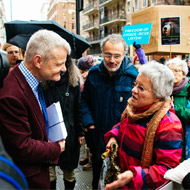
Petition signed by more than 15,000 people
The RCVS has received a petition voicing vets’ concerns over the College’s recent position statement on complementary and alternative medicine.
The petition, signed by more than 15,000 people, was handed to the RCVS on Monday (15 January) by a delegation of around 40 animal owners and veterinary surgeons.
RCVS president Stephen May and CEO Lizzie Lockett met the delegation and spent time hearing accounts and stories from the supporters. In view of the bad weather, they invited the supporters inside for hot drinks, but the invitation was declined.
Stephen May commented: “We were pleased to be able to meet our visitors today and to receive their petition, although it was a little tricky trying to answer questions on a busy London pavement!
“We continue to recognise that homeopathy and other complementary therapies are popular amongst some animal owners and certain members of the veterinary profession, as indicated by today’s delegation, but it is worth reiterating that the RCVS Council statement does not ban their use.”
He continued: “What it does state, is that in order to protect animal welfare, we regard such treatments as being complementary, rather than alternative, to treatments for which there is a recognised evidence base or which are based on sound scientific principles.
“This is similar to the position that we have held on complementary therapies for many years, but we will always be happy to receive and consider scientific evidence that demonstrates their efficacy.”
The protest was organised by the British Association of Homeopathic Veterinary Surgeons (BAHVS), which has been campaigning for the College to retract its statement on the use of complementary and alternative medicine (CAM).
Vets, animal lovers and their pets met outside the Houses of Parliament before marching towards the RCVS headquarters on Horseferry Road. Junior vice president Ilse Pedler of the BAHVS said that further events are being planned for later in the year.
Image (C) RCVS


 Companies marketing medicines for small pets exempt from authorisation must submit their annual return to the Veterinary Medicines Directorate (VMD) by 30 November 2026.



