


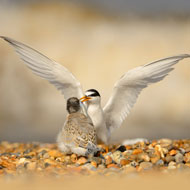
One of the UK’s rarest seabirds, the tern, has overcome a range of natural and man-made threats to raise over 600 chicks this year, the RSPB has said.
Terns fly thousands of miles from Africa each year to raise their chicks on UK beaches. But the species has suffered an 18 per cent decline in numbers since 2000 and there are thought to be fewer than 1,600 pairs left.
An RSPB survey of key sites found 1,077 adult birds made it to our shores during the summer to raise 617 chicks. The Norfolk coast was a stronghold, with 260 chicks raised across Winterton and Blakeney point. Grognant Beach in Wales also had a good season with 202 young.
The breeding season was described as ‘remarkable’ by the RSPB as the seabird faces a number of natural and unnatural threats, including poor weather and deliberate nest destruction.
Terns lay their eggs on the beach, often close to the sea. Their nests frequently get washed away as a result of big tides and stormy weather and, as their eggs are camouflaged, they are vulnerable to accidental disturbance by passers-by.
RSPB said this year proves deliberate nest disturbance is another factor preventing terns from making a full recovery. Colonies in Crimdon, near Hartlepool, and Kessingland in Suffolk, lost more than 60 eggs when nests were intentionally destroyed.
Tidal surges were also destructive to nests at Blackwater Estuary in Essex and Scott Head Island in Norfolk. Chicks at Long Nanny, Northumberland, suffered from predation by other species.
Together with various groups and local communities, the RSPB is working to protect terns. Project manager Susan Rendell-Read, said the main focus is to improve and create nesting sites above the high tide marks. Although this work is in its early stages, the new figures show there has already been a steady increase in numbers since 2013, when 524 fledgings were recorded.
RSPB conservation director Martin Harper, said: “We need places that are rich in wildlife and that can be enjoyed by all. Little terns are one of a number of species that have benefited from the protected areas around the country. As we leave the EU, we need to protect these spaces and create new places for wildlife so that nature can adapt to future changes and thrive throughout the UK.”
Image © RSPB


 Companies marketing medicines for small pets exempt from authorisation must submit their annual return to the Veterinary Medicines Directorate (VMD) by 30 November 2026.



