
Your data on MRCVSonline
The nature of the services provided by Vision Media means that we might obtain certain information about you.
Please read our Data Protection and Privacy Policy for details.

In addition, (with your consent) some parts of our website may store a 'cookie' in your browser for the purposes of
functionality or performance monitoring.
Click here to manage your settings.
If you would like to forward this story on to a friend, simply fill in the form below and click send.

Your friend's email:
Your email:
Your name:
 
 
Send Cancel

Large and small vertebrates ‘most at risk of extinction’
A review of the key drivers of extinction risk showed that the heaviest animals are most threatened by hunting.

Researchers analyse global database of body masses

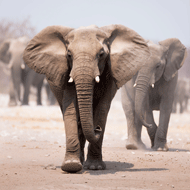
The world’s biggest and smallest vertebrates are at most risk of extinction, according to new research.

The study, published in Proceedings of the National Academy of Sciences of the United States of America, reveals the likelihood of being threatened is significantly related to body size for birds, fish and mammals.

In the collaborative study, researchers built a global database of body masses for some 27,000 vertebrate species assessed by the International Union for Conversation of Nature’s Red List.

They found that the extinction risk changes around a body mass breakpoint of 0.035kg, suggesting that the lightest and heaviest animals have elevated extinction risk.

A review of the key drivers of extinction risk showed that the heaviest animals are most threatened by hunting, while the lightest animals are threatened by habitat loss due to logging and pollution.

Researchers said that knowing which creatures are at risk can help focus conservation efforts.

‘Our results offer insight into halting the ongoing wave of vertebrate extinctions by revealing the vulnerability of large and small taxa, and identifying size-specific threats,’ the authors write.

‘Moreover, they indicate that, without intervention, anthropogenic activities will soon precipitate a double truncation of the size distribution of the world’s vertebrates, fundamentally reordering the structure of life on our planet.’


Become a member or log in to add this story to your CPD history

BSAVA partners with BVA Live 2026

News Story 1
 BSAVA is to partner with BVA Live (11-12 June 2026) to champion clinical research.

The organisation will be supporting BVA Live's Clinical Abstracts programme, showcasing selected abstracts of veterinary research throughout the event.

The clinical abstracts can be on any small animal veterinary subject, and must be based on research undertaken in industry, practice or academia. Abstracts can be presented in poster or oral formats.

Submissions will open on 15th December 2025, and close on 6th March 2026. You can register interest here

Click here for more...
News Shorts
Nominations open for RCVS and VN Council elections

The nomination period for the 2026 RCVS Council and VN Council elections is now open, with three veterinary surgeon seats and two veterinary nurse seats available.

Prospective candidates can download an information pack and nomination form from the RCVS website. Individuals can nominate themselves for the elections, with the results to be announced in the spring.

Clare Paget, the recently appointed RCVS Registrar and elections returning officer, said: "If you want to play your part in influencing and moulding how the professions are regulated, and making key decisions on matters of great importance to your peers, the public and animal health and welfare, please consider standing for RCVS Council or VN Council next year."

Nominations close at 5pm on Saturday, 31 January 2026.

