


Avoiding swill ‘more important than ever,’ say vets
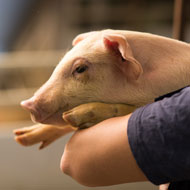
It is illegal to feed kitchen waste or vegetarian scraps to pigs.
Pig keepers are being reminded to avoid swill feeding following Defra's recent announcement that the risk of an incursion of African Swine Fever (ASF) in the UK has risen from ‘Very Low’ to ‘Low’.
While there is no risk to human health, ASF is highly contagious. In recent months, cases have moved steadily South-West across Europe, prompting Defra to raise the risk level here in the UK.
Cases have been reported in Romania, Poland and The Czech Republic - the latter being of particular concern as ASF has ‘jumped’ a country, suggesting a new route of infection. Most cases have been in wild boar, but a significant number of backyard sites and a small number of commercial herds have also reported the disease.
BVA senior vice president John Fishwick commented: “The route of spread in most cases has been through contact with wild boar, and due to lapses in biosecurity measures. However, some cases have arisen through animals being fed swill which has been contaminated with infected meat. This means it is more important than ever that all pig keepers avoid feeding food waste of any kind to their animals.
“Backyard keepers may believe that it is harmless to feed kitchen waste or vegetarian scraps to their pigs but this is illegal for a reason. Cross contamination can easily occur and live virus particles have been found on food packaging at one of the infected commercial herds.”
As well as it being illegal to feed food scraps to pigs, owners must ensure that wild or feral pigs cannot gain access to domestic or catering waste in bins. They must also be prevented from coming into contact with domestic pigs and herds.
Pig Veterinary Society president Mark White said: “Pigs with clinical African Swine Fever most commonly show signs of fever, inappetence, lack of energy and sudden death. There may also be signs of vomiting, diarrhoea, red or dark skin, laboured breathing or coughing, abortion stillbirths and weak piglets born.
“There is no risk to human health from this disease, but it could have an enormous impact on pigs in this country and would devastate our pig industry. This would have a consequential impact on the cost of pig meat to consumers.”
Disease experts are worried that ASF could spread west to countries with a high density of wild boar, such as Germany. In the Forest of Dean, Sussex, Kent, Dorset, Central Perthshire, Dumfriesshire and Lochaber there are several breeding colonies of wild boar and feral pigs.
Anyone with any suspicion of the presence of ASF is urged to report to local animal health and welfare services immediately. Contact information for the Animal and Plant Health Agency (APHA) or devolved equivalent and more information about ASF can be found at https://www.gov.uk/guidance/african-swine-fever


 Companies marketing medicines for small pets exempt from authorisation must submit their annual return to the Veterinary Medicines Directorate (VMD) by 30 November 2026.



