
Your data on MRCVSonline
The nature of the services provided by Vision Media means that we might obtain certain information about you.
Please read our Data Protection and Privacy Policy for details.

In addition, (with your consent) some parts of our website may store a 'cookie' in your browser for the purposes of
functionality or performance monitoring.
Click here to manage your settings.
If you would like to forward this story on to a friend, simply fill in the form below and click send.

Your friend's email:
Your email:
Your name:
 
 
Send Cancel

Japanese monkey displays mating behaviour with deer
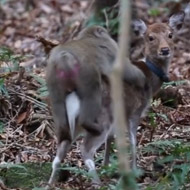
Researchers observed a male Japanese macaque trying to mate with a female sika deer.

Incident observed on Yakushima Island

A male Japanese monkey has been observed trying to mate with female sika deer.

The incident was filmed by researchers on Yakushima Island, Japan, and is described in the journal Primates.

The researchers say that while Japanese macaques are known to ride deer in a playful manner, this particular monkey displayed obvious sexual behaviour towards several female deer.

‘Although this phenomenon may be explained as copulation learning, this is highly unlikely,’ the authors write.

‘The most realistic hypothesis would be that of mate deprivation, which states that males with limited access to females are more likely to display this behaviour.

‘Whatever the cause for this event may be, the observation of highly unusual animal behaviour may be a key to understanding the evolution of heterospecific mating behaviour in the animal kingdom.’

This is not the first example of mating behaviour between different species. In 2014, Antarctic fur seals were caught trying to mate with king penguins.

The study, which made headlines around the world, found that some penguins were eaten and killed after the mating occurred.

Image (C) Alexandre Bonnefoy

Become a member or log in to add this story to your CPD history

Annual submission deadline small pet animal exemptions

News Story 1
 Companies marketing medicines for small pets exempt from authorisation must submit their annual return to the Veterinary Medicines Directorate (VMD) by 30 November 2026.

Submitting this annual return ensures continued compliance with regulatory requirements for products marketed without a full Marketing Authorisation. The exemption specifically applies to products intended for animals, cage birds, terrarium animals, small rodents, ferrets and rabbits.

For further details and submission guidelines, visit the gov.uk website.  

Click here for more...
News Shorts
Bluetongue RZ extended across Scotland

The Scottish Government has announced an extension to a Bluetongue Restricted Zone that is in place in south-west Scotland.

From 3 October, the Restricted Zone will be extended to cover the whole of Scotland. The Animal, Plant and Health Agency (APHA) says this is in response to further disease spread, as well as simplify trading conditions ahead of the autumn.

Since the whole country will share a disease status, it will no longer be necessary to have a movement license to move susceptible livestock around the country. Restrictions on germinal products remain.

As of 1 October 2026, there were 1,979 cases of BTV-3 in England, 389 cases in Wales and 40 cases in Scotland.

