


Species lays its eggs on rocks rich in precious metals
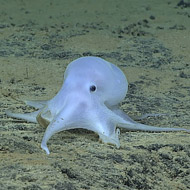
A ‘ghostlike’ species of octopus which was discovered in February is under threat from deep sea mining, new research suggests.
The octopus, nicknamed Casper, was discovered around 3.5 miles off the coast of Necker Island, Hawaii, at a depth of 4,000 meters.
Recent studies of the octopus show that the animals deposit their eggs onto the stems of dead sea sponges, which in turn grow on manganese nodules. These are concentrations of rock that contain precious metals used in the production of mobile phones and computers.
"Presumably, the female octopod then broods these eggs, probably for as long as it takes until they hatch - which may be a number of years," explains Autun Purser of the Alfred Wegener Institute's Helmholtz Centre for Polar and Marine Research in Germany.
"The brooding observation is important as these sponges only grow in some areas on small, hard nodules or rocky crusts of interest to mining companies because of the metal they contain. The removal of these nodules may, therefore, put the lifecycle of these octopods at risk.”
Observations have revealed that the octopods are numerous in manganese crust areas, precisely where miners would hope to extract metals of interest.
In a series of recent expeditions, the researchers set out to find the organisms that live there and to understand how mining might impact the ecosystem and animals.
"As long-lived creatures, recovery will take a long time and may not be possible if all the hard seafloor is removed," Purser says.
"This would be a great loss to biodiversity in the deep sea and may also have important knock-on effects. Octopods are sizeable creatures, which eat a lot of other smaller creatures, so if the octopods are removed, the other populations will change in difficult to predict ways.”
The research, Association of deep-sea incirrate octopods with manganese crusts and nodule fields in the Pacific Ocean" is published in Current Biology.
Image (C) NOAA Office of Ocean Exploration and Research


 Companies marketing medicines for small pets exempt from authorisation must submit their annual return to the Veterinary Medicines Directorate (VMD) by 30 November 2026.



